
The right front porch planter depends on whether you own the steps or answer to a landlord.
Cast-iron urns and stone lions anchor a door with permanence, but their weight scars decking and turn moving day into a two-person job; resin copies cut heft by half without losing the silhouette from the curb.
A 28-inch column planter gives renters vertical presence they can haul to the garage before a freeze, while a wall-mounted pocket system comes down in minutes but demands daily watering through July.
1. Classic Urn Planters
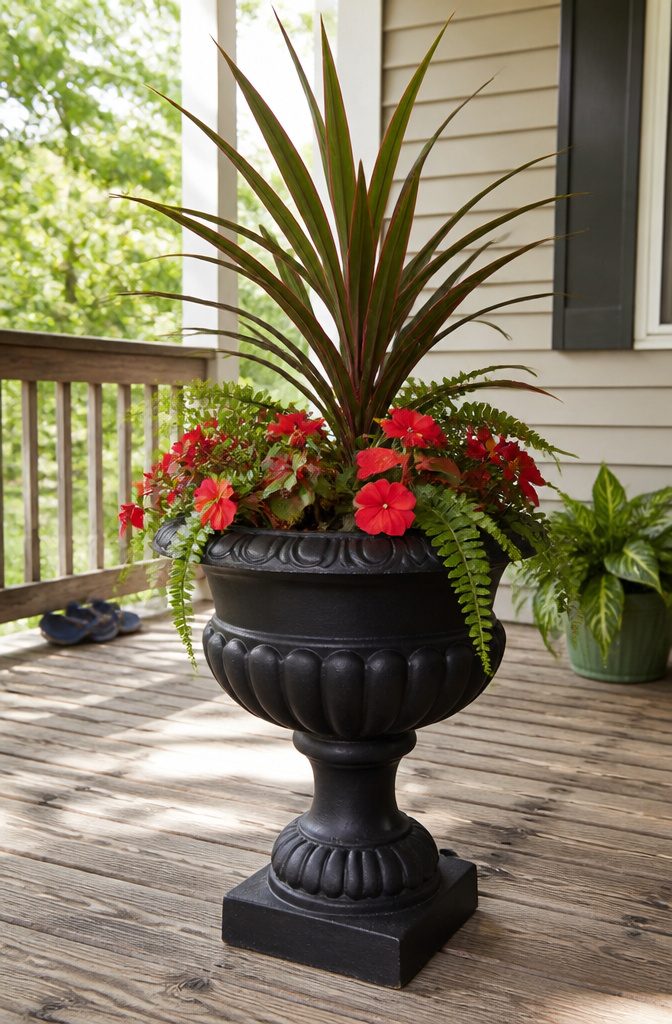
A cast-iron urn with a black finish anchors a porch without competing with the architecture.
The weight sits low in the base, which matters more than height when wind hits; most that hold up year after year run 24–30 inches tall overall, with the bowl itself accounting for about two-thirds of that.
The fill-spill-thrill formula actually works here because the curved sides hide soil lines.
A tall spiky center, something like a dracaena or cordyline, gives the height, then flowing baby’s breath or a soft fern bridges the gap, and red impatiens or lobelia spill over the rim so the urn reads as full from the street.
One urn this size beats three small pots that dry out at different rates and never look planned.
The catch is the material: cast iron holds moisture against the finish, so the base plate needs checking after hard winters, and the piece is heavy enough that moving it for sweeping means sliding, not lifting.
For renters, that weight is the tradeoff. The urn stays put, but so does any mark it leaves on decking.

Rotation Molded Plastic
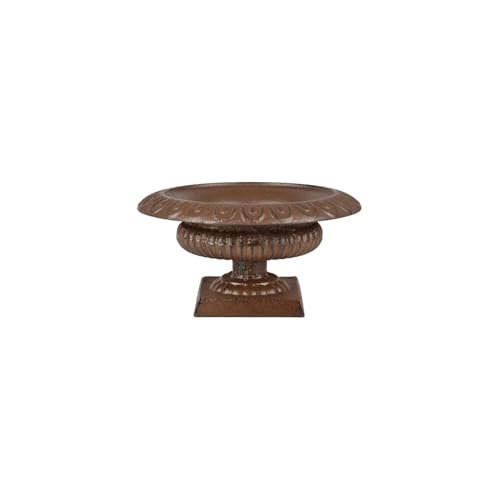
Product Dimensions: 7.8'x7.9'x4.05'

【Vintage Stylish Design】This classic urn‑shaped garden planter comes with delicate woven embossed texture and antique‑brown tone finish. Its timeless rustic aesthetic matches patio, lawn, pathway and courtyard landscape well. It functions both as a practical flower pot and an elegant garden decorative ornament.
2. Lattice Design Square Planters
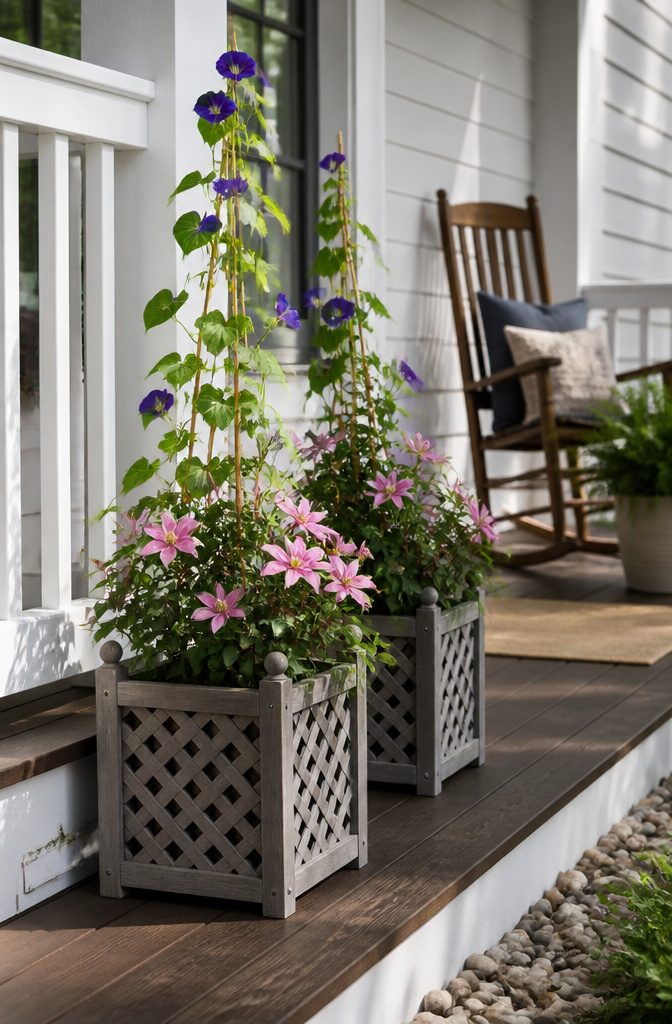
Square planters with lattice sides give a front porch its vertical line without the fuss of a full trellis installation.
The grid pattern works hardest when it actually supports something: morning glory, clematis, or a compact climbing rose will thread through and fill the frame by midsummer.
Left bare, the lattice reads as texture, which suits a porch that already has enough going on at eye level.
The practical difference shows up in placement.
A lattice planter set against a railing or narrow wall gains depth from the climbing growth; freestanding on wide steps, the same planter often looks busy on all four sides and competes with whatever sits behind it.
Training one or two vines keeps the structure from flattening into pure decoration.
Resin versions with molded lattice detail are widely available now, some with knock-out drainage holes already punched.
The recycled resin formulas carry less weight than they look like they should, which matters on a rental porch where you may need to haul them in before a freeze.

Classic Urn Shape: 14-inch black resin planter brings a formal, pedestal-style silhouette to patios, porches, and entryways
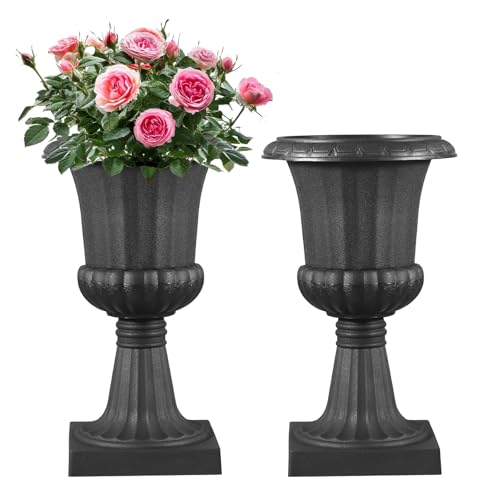
Large Opening Planter Urn: With a height of 16.54 in / 42 cm and a 9.84 in / 25 cm wide opening, this urn planter is suitable for clematis, hydrangeas, roses, and more, giving your plants the ideal space to thrive

Year-Round Seasonal Porch Decor: Bring seasonal charm to your entryway with this decorative urn planter, perfect for displaying faux fall flowers, artificial mums, Halloween floral arrangements, and winter greenery. Style it with pumpkins for fall porch decor or evergreen branches and festive accents for Christmas porch decorations. This versatile flower pot adds a welcoming touch to your front porch, entryway, patio, or outdoor seasonal displays
3. White Stone Planters
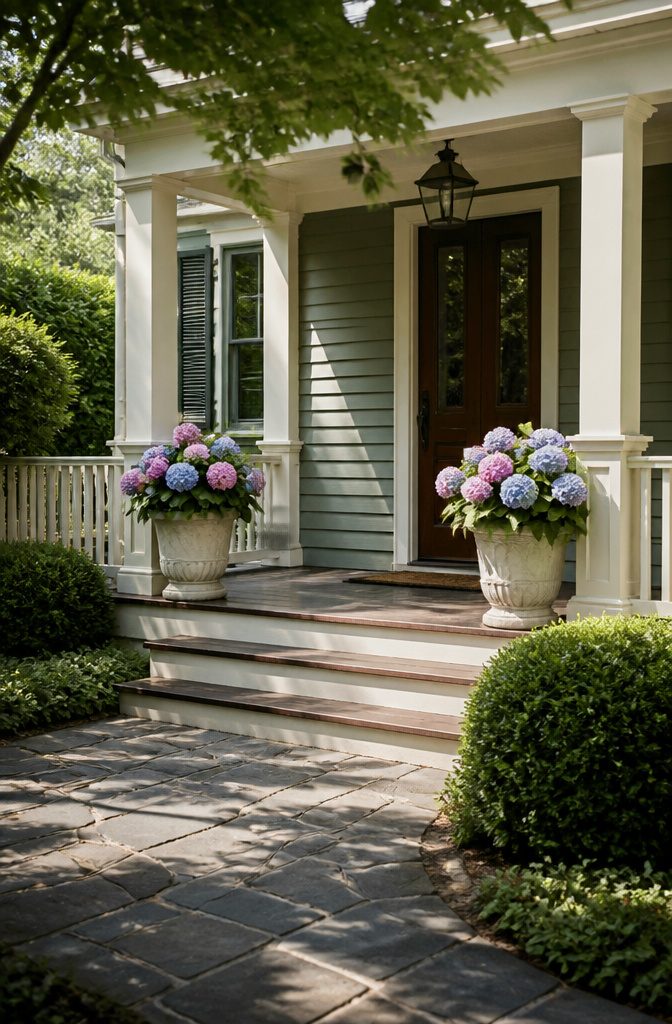
White stone planters carry enough visual weight to anchor a porch without shouting for attention.
Cast concrete or carved limestone versions start around thirty pounds for a twelve-inch pot and climb fast from there, so a rental with steps or a wooden deck needs a plan before delivery day.
Most come with a single drainage hole that sits flush against a saucer; on a painted porch, that saucer matters more than the plant inside.
The finish behaves differently depending on exposure. Full sun turns the surface warm to the touch and can yellow certain sealers over a season, while shade keeps the cool tone but invites algae into every porous patch.
Either way, the pale color shows water stains immediately, so hard water or overhead sprinklers become a maintenance routine, not an afterthought.
Soil volume is where weekend watering turns into a real schedule.
A sixteen-inch cube holds roughly twice what a standard terracotta pot of the same width manages, which means a hydrangea or small boxwood survives a missed Friday but rots fast if Tuesday’s check gets skipped too.
The stone breathes slower than clay, so the center stays wet longer than the surface suggests. My finger goes in two knuckles deep, every time, before I add anything.

LARGE OUTDOOR PLANTER - This 14.75-inch-square large plant pot is perfect for holding potted plants while providing a decorative cover for growing pots. The elegant lattice design adds a farmhouse touch to this deck or front porch decor.

LARGE OUTDOOR PLANTER 2-PACK - This 14.75-inch-square large plant pot set is perfect for holding potted plants while providing a decorative cover for growing pots. The elegant lattice design adds a farmhouse touch to this deck or front porch decor.

This planter with trellis is made of a strong carbon steel base. It's sturdy and solid for long time and durable usage. Moisture Resistant,Maintain beauty and performance.
4. Tall Column Planters
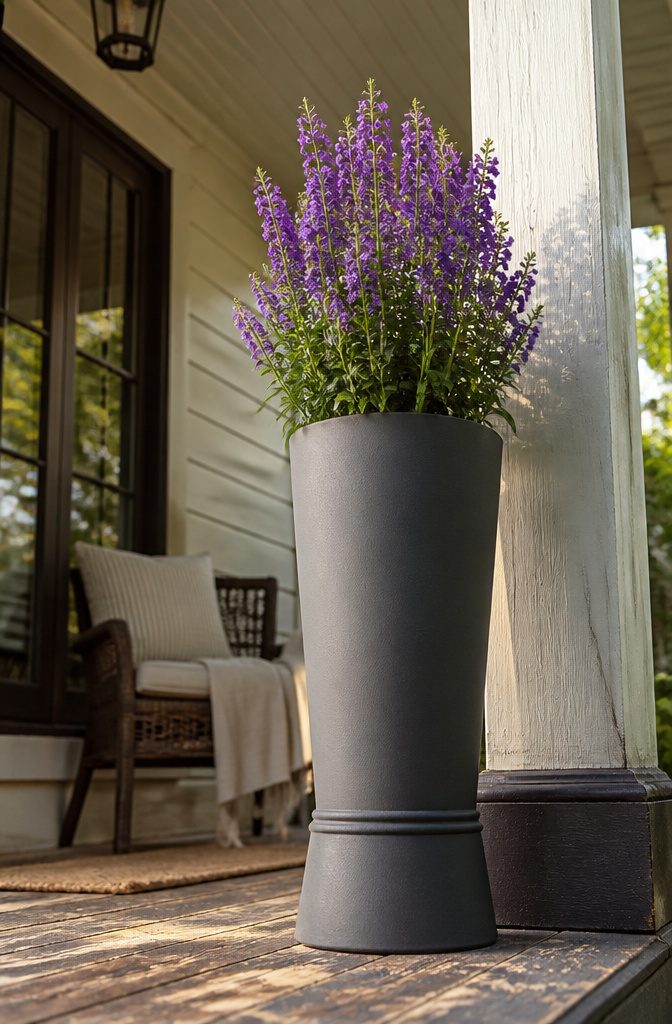
A 28-inch column planter gives you vertical presence without eating floor space on a shallow porch.
The narrow footprint works best with plants that reach upward rather than spill wide: angelonia sends up tall stems of small orchid-like flowers from late spring straight through frost, or a compact rose such as Ringo can sit at the base while a climber like Rise Up Emberays gets trained against a porch pillar for height.
Wind is the real enemy with anything this tall and slim.
Weight matters more than width. Pack the lower third with something dense, a few bricks or a bagged rock layer, before you add soil.
Some column planters come with a false bottom you can set at three different heights, which helps anchor the root ball lower in the pot and keeps the center of gravity down.
On steps, set the planter back against the riser rather than the tread edge, or one good gust sends it tumbling. A landing deep enough for a doormat is usually deep enough for one of these.
If your porch is shallow enough that the door nearly grazes the railing, a pair flanking the top step reads as entry framing without blocking the path.

{Premium Material}: Our garden wall planters bags choosing high-quality felt materials with good air permeability can better store and release water to promote healthy plant growth. It is lightweight, sturdy, convenient, foldable, durable and anti-aging.

【Create a Modern Living Wall】Transform blank walls into a stylish vertical garden with this modular wall planter system. self watering pots Perfect for displaying herbs, succulents, flowers, pothos, and small indoor plants while maximizing unused wall space

【Pack of 2】If you want to decorate your walls with plants, this 18 pockets hanging planter is a good choice. Compared with normal planters, this kind of wall-mount grow bag allows you to grow large amounts of plants without taking up much space.
5. Square Lion’s Head Planters
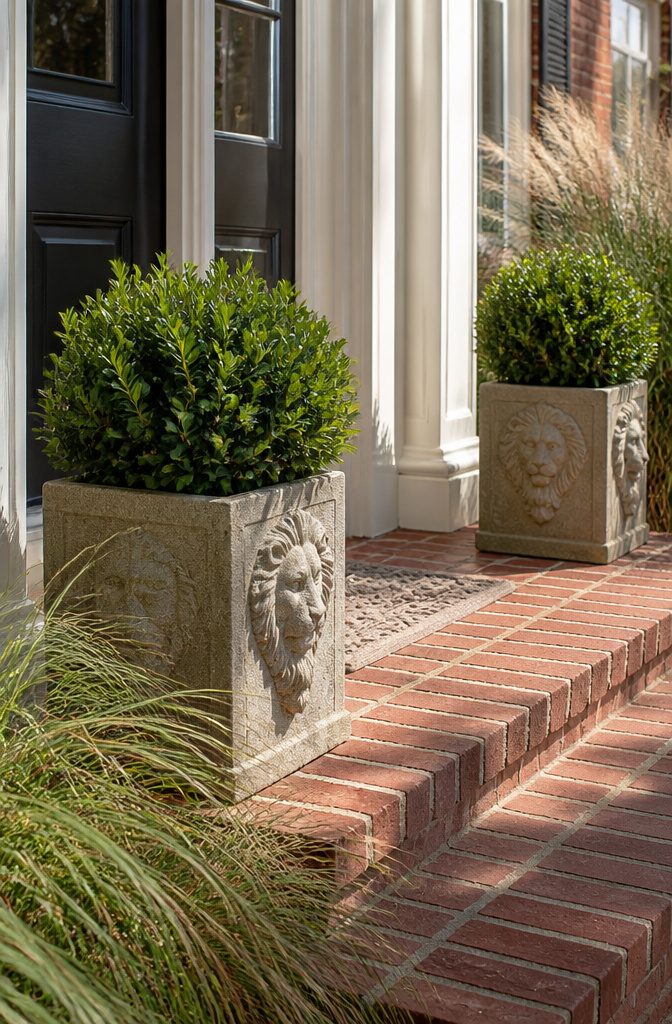
A square lion’s head planter carries enough formality to hold its own against a paneled front door or symmetrical porch columns.
The molded face reads clearly from twenty feet away, which is about where most sidewalk viewers stand, and the square footprint gives roots more room to spread than a tapered pot of the same width at the rim.
The architectural fit matters more than the plant choice here.
These planters belong with brick, limestone, or any entry that already has classical detail: fluted pilasters, a pediment, even just heavy crown molding. Against clean modern siding, the lion heads look like costume jewelry, too insistent for the setting.
The square base also changes how you arrange them. A round pot looks fine angled on a step corner; a square one wants to sit flat against a wall or aligned dead-center on a landing.
That rigidity limits placement options, but it also means two of them will frame a door with mathematical precision. For renters, the weight is the real limit.
Empty, a cast-stone version can run past fifty pounds, so moving day becomes a two-person job or a sale listing. Resin copies cut that by half and still cast the same shadow from the street.

VERSATILE DECOR: Ideal for home, office, or event styling, adding a touch of greenery to any space.

Modern Concrete Planter – Experience a contemporary design that effortlessly blends graceful curves with a fluted surface, radiating an authentic, natural charm. Elevate your space with this modern masterpiece, adorned with subtle visible pores that add an enchanting touch of organic elegance and sophistication.

Rustic Style Planter: Inspired by vintage clay jars, this planter pot features a rounded shape and distressed stone-look finish. The weathered surface adds natural charm and suits farmhouse, contemporary, rustic, or minimalist decor.
6. White Beaded Urn Planters
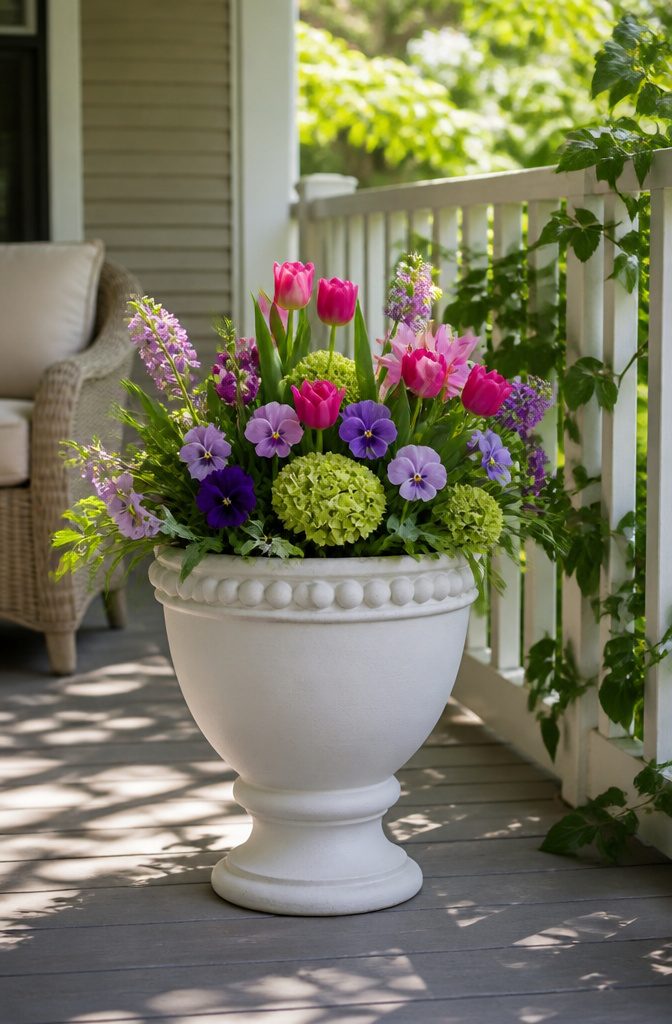
The beaded rim on these urns reads as carved stone from the curb, but pick one up and the weight gives it away: 100% recycled resin, hollow and manageable.
That rim detail catches pollen, splashed soil, and the gray film that builds on white planters after a rainy month.
A toothbrush and soapy water fixes it, which is more maintenance than a smooth urn demands, though the shadow line the beads throw in late light can be worth the trade on a porch that reads flat otherwise.
On a small porch, one beaded urn usually lands better than a pair. The extra visual weight competes when doubled, especially where the door itself has panel molding or a busy color.
The My Texas House line at Walmart runs these in white with knock-out drainage holes; you punch through with a screwdriver rather than drilling.
The finish is paint over resin, not stone, so chips show resin beneath rather than matching stone. Touch-up with exterior trim paint in a close white works, but the match is never exact.

Timeless Design: Perfect for adorning entryways, porches, and patios, showcase plants beautifully in this fluted garden urn that features graceful lines and an ornamental rim.

Durable Polypropylene Construction: Lightweight yet robust polypropylene planters ensure long-lasting durability and easy mobility for any gardening enthusiast

Lightweight Planter: Keep your plants safe and sound with this large plant pot designed to work well with many different kinds of plants from flowers to shrubs to herbs
7. Basket Planters
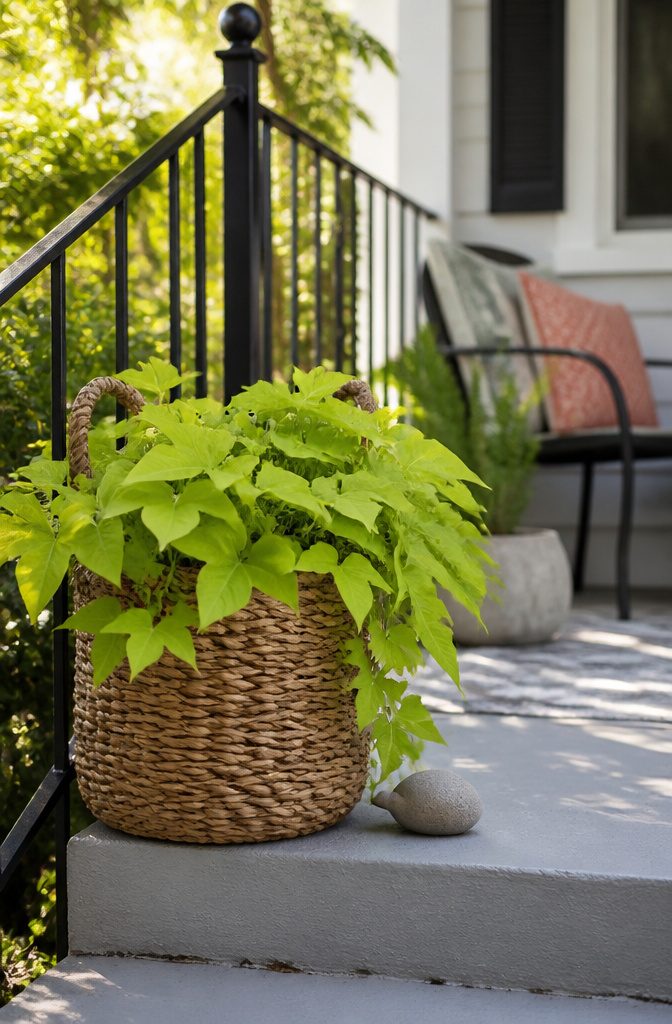
Woven baskets soften a porch in a way pottery never quite manages.
The trick is accepting that a coco liner lasts one, maybe two seasons before it sheds fibers and lets soil wash through. Replacement liners run cheap, but swapping them out is a spring chore that piles up.
Wire baskets with built-in reservoirs slow the drying problem slightly; unlined wicker without any barrier turns into a wicking system that pulls moisture straight out of the root ball on hot afternoons.
Standing basket planters, the kind that sit directly on the floor or a low riser, read casual against shaker siding or a painted concrete stoop.
Hanging versions shift the whole look upward and work better on porches with narrow floor space, though the wind catches them harder and the watering schedule tightens.
Either way, the informal texture pairs naturally with trailing sweet potato vine or something loose like asparagus fern. Tight topiary shapes fight the form and usually look like a mistake someone tried to dress up.

Year-Round Seasonal Porch Decor: Bring seasonal charm to your entryway with this decorative urn planter, perfect for displaying faux fall flowers, artificial mums, Halloween floral arrangements, and winter greenery. Style it with pumpkins for fall porch decor or evergreen branches and festive accents for Christmas porch decorations. This versatile flower pot adds a welcoming touch to your front porch, entryway, patio, or outdoor seasonal displays

BALANCED ENTRANCE DISPLAY – Place one matching planter on each side of a front door, porch step or patio entrance for a coordinated look. The pair also works well along balconies, covered porches and garden paths.

CLASSIC PEDESTAL URN DESIGN (SET OF 2): Timeless architectural urns with a pedestal profile, designed to frame entryways, front porches, patios, and garden paths with symmetry and presence.
8. Black Urn Planters
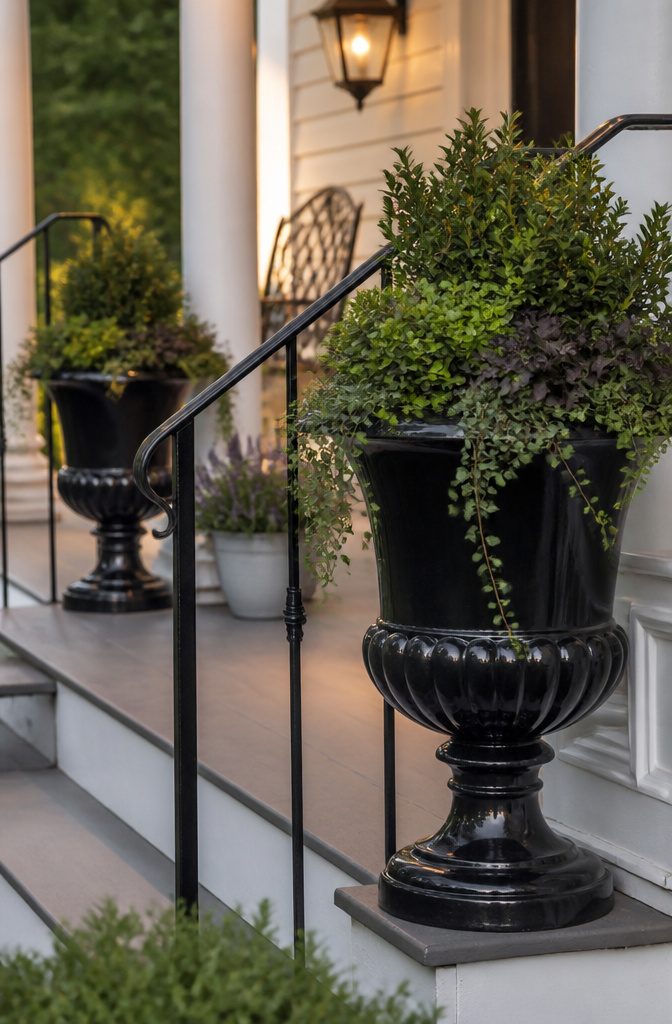
Black urn planters carry a formality that white ones soften into something more cottage-garden. The dark finish reads estate entrance, which works on porches with columns or heavy trim, but can feel imposing against light siding or a small stoop.
Heat is the real issue in direct sun: the surface absorbs enough warmth to stress roots and dry soil faster than a light-colored pot of the same size, so black urns need more frequent watering in July and August, or placement where they catch morning light only.
The finish also shows every water spot and dust film.
What reads as patina on weathered bronze reads as neglect on a flat black surface, so the planter demands either a glossy glaze that wipes clean or a textured cast surface that hides the film in its shadows.
Material matters for holding the color. Powder-coated aluminum keeps its black through seasons without the chalking you see on cheap painted resin.
Fiberstone, a mix of fiberglass and crushed stone, gives the weight and matte depth of cast concrete without the porosity that draws moisture and causes freeze-crack in northern winters.
Glazed ceramic holds color forever but runs heavy and expensive; for a renter wanting two matching flanking pieces, it is probably more commitment than the porch justifies.
I would skip the black urn entirely on a porch that bakes past noon, unless the plan is succulents or something equally indifferent to root heat. Shade or dappled light makes the choice far more forgiving.

【Rust-Resistant Material】: Cucumber trellis is constructed with high-quality galvanized steel inner pipes and an exterior plastic coating, forming a dual-layer rust-proof barrier to ensure long-lasting durability

LARGE OUTDOOR PLANTER 2-PACK - This 14.75-inch-square large plant pot set is perfect for holding potted plants while providing a decorative cover for growing pots. The elegant lattice design adds a farmhouse touch to this deck or front porch decor.

VERSATILE - Removable and attached saucer is ideal for indoor and outdoor spaces.
9. Metal Planters on Stands
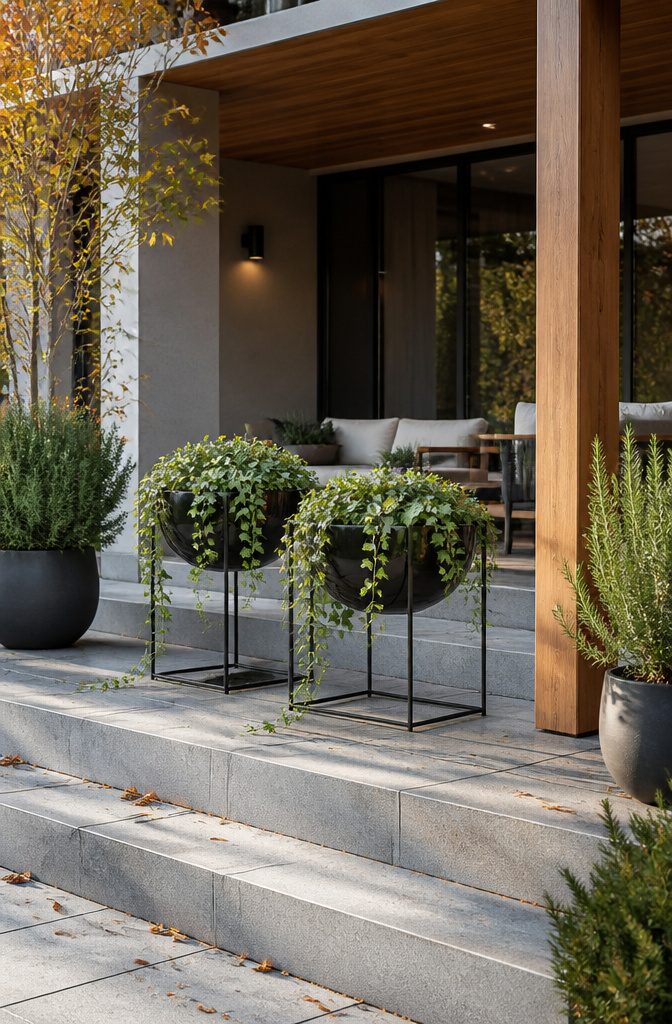
Metal planters on stands lift greenery to eye level before a guest even reaches the door.
The raised profile gives small porches a vertical line that reads as architecture instead of clutter, and the gap underneath keeps the floor visible so the space does not feel walled in.
The elevation also moves plants off cold concrete and away from splashback during rain, which helps drainage and root health.
Powder-coated or galvanized finishes resist rust longer than raw steel, though any scratch will eventually bloom if you do not touch it up.
Weight sits higher with these, so a stand on a sloped porch needs checking after hard wind; a full planter of wet soil can torque a light frame.
The industrial look pairs well with simple evergreens or trailing ivy, but the metal reads cold without something soft against it.
I would skip the tiny stands meant for desks; on a porch they look provisional. A 20–24 inch height hits the railing line on most standard stoops and lets the plant share the view instead of blocking it.

Innovative Space-saving Design: maximize your gardening potential with our stackable wall planter system; Each piece measures 9.45" x 5.71" x 5.51" and features two pockets, The overall dimensions are 47.5"x33"x5.5" offering ample growth space for a variety of plants; Nice for Fence Balcony Wall Decor, these vertical wall planters change limited spaces into gardens effortlessly
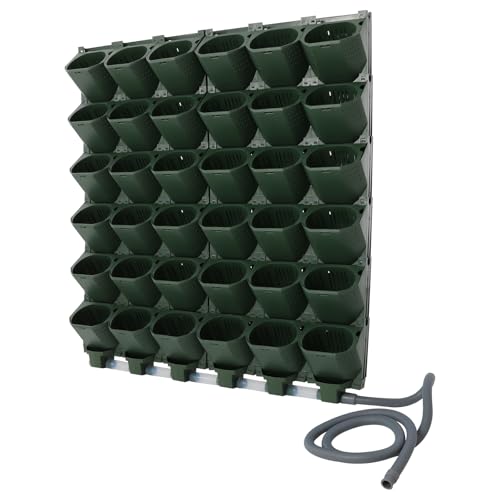
【Smart Timer & Rain Sensor】Equipped with a timer, you can easily set watering intervals (1h-30d) and duration (1s-999m). The intelligent rain sensor (IPX6 water-proof) automatically pauses irrigation on rainy days, preventing overwatering and saving water. Perfect for business trips and holidays.
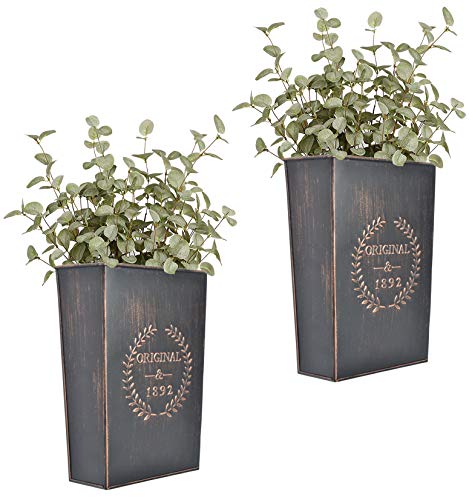
✅FARMHOUSE GALVANIZED WALL PLANTERS:This is a unique set of two galvanized metal wall planters,wall planters are made of high quality galvanized metal and hand painted,coated to prevent rusting,features a vintage finish. Rustic wall decor in your home, planters are great for displaying artificial greenery plants, faux flowers, floral arrangements, seasonal decorations, shrub bouquet, foliage, fake lavender, eucalyptus plants, or cotton,ideas are endless.
10. DIY Monogrammed Planters
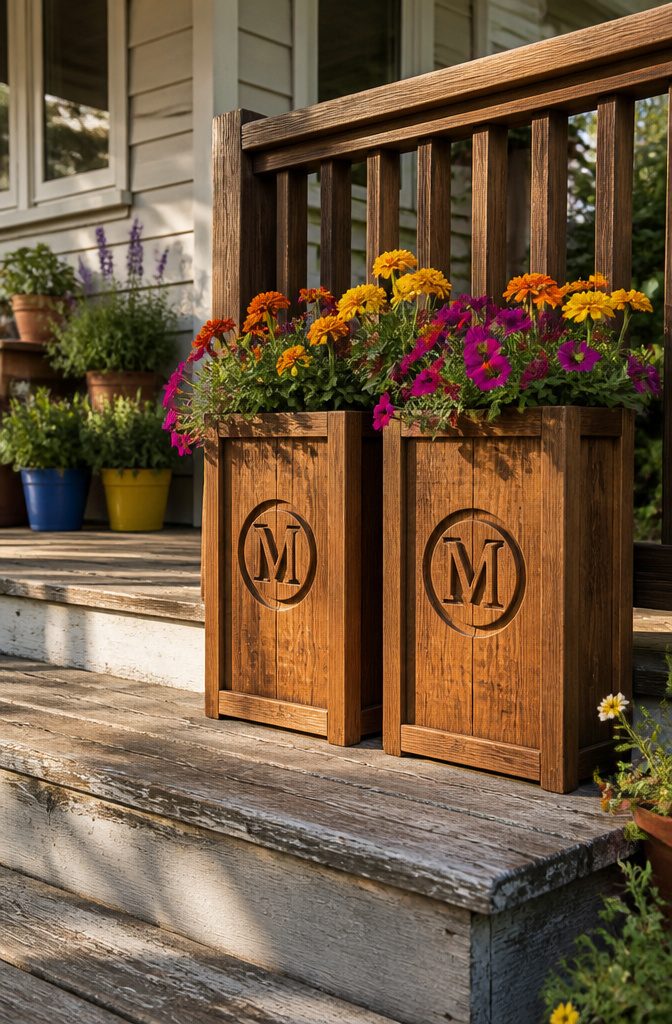
A plain cedar box or a pair of metal planters on stands both take paint well, but only wood lets you carve deep enough for a monogram to survive more than one season of swelling and contraction.
The gatehouse planters I kept coming back to started as raw wood, got their letters routed in, then held black paint against Kentucky winters for years without the detail washing out.
That is the test: if the letter sits on the surface like a decal, sun and rain peel it back to anonymity by August.
Metal planters on stands move easy and mix with other pieces, yet their finish fights adhesion.
You would spend more time sanding and priming than cutting letters, and the result still chips where the stand meets the box. Carved wood, painted solid, is the only monogram that earns its keep outdoors.
For renters, the time only pays out if you already own the tools. A router, a straight bit, and exterior paint run the job to a Saturday plus drying time.
Buy the planters finished and add vinyl letters instead if the toolbag is empty; the swap costs less than the bit set and leaves no scar when the lease ends.
Owners staying put five years or more get the better deal making their own.
The monogram stops being decoration and starts reading as architecture, the kind of detail that survives on a porch long after the annuals inside it have turned.
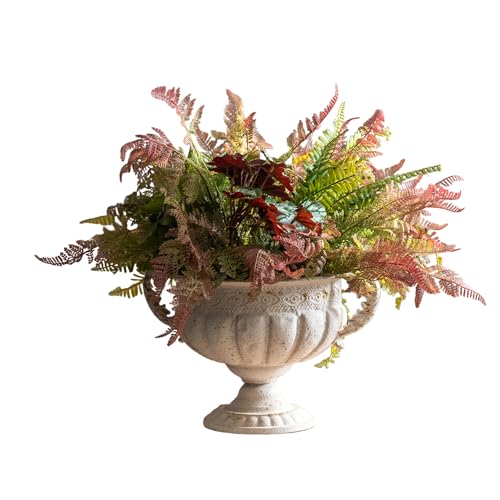
Vintage Urn Planter with Timeless Charm – Featuring a classic round urn shape with antique imitation stonefinish and embossed patterns, this decorative planter adds a touch of old-world elegance to your garden, patio, or home.

AUTHENTIC STONE APPEARANCE: Creates a distinctive textured finish that gives interior décor and accent pieces a natural stone look.

This minimalist stoneware planter features a unique, cheese cloth texture in a stylish matte finish
11. Boxwood Planters
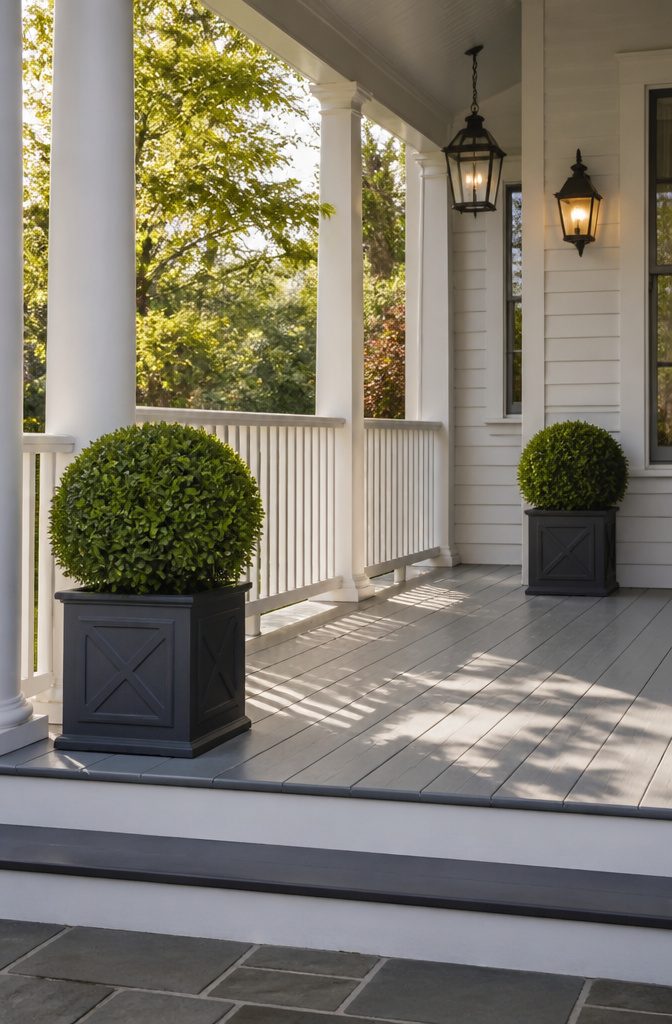
Boxwood shrubs handle the light lottery most porches deal out, thriving anywhere from full sun to shade without turning patchy or thin.
That flexibility matters more than it sounds: a planter that sits pretty in June can look ragged by August if the sun angle shifts and the plant can’t adapt.
Growth in containers stays slow enough that repotting is a years-apart task, not an annual chore.
A compact variety like Sprinter keeps a dense, glossy habit without demanding constant shearing into shape, though it takes one readily if you want a more formal look.
The real question is whether to commit to live plants or go artificial.
Live boxwoods survive winter in their pots if you keep watering weekly even when the plant looks dormant and tuck them under cover during extreme cold, which is work a renter might not want.
Artificial boxwoods skip that entirely and still read green from the street, though they age faster than you’d expect in UV.
Drainage holes are non-negotiable, especially in an uncovered spot where rain collects. A 20-inch height and 22-inch width gives the root ball room without overwhelming a standard porch step.
Plan on three to five years before a live boxwood outgrows a pot that size and needs transplanting or replacement, longer if you start with a smaller specimen and let it fill in.
12. Hanging Baskets
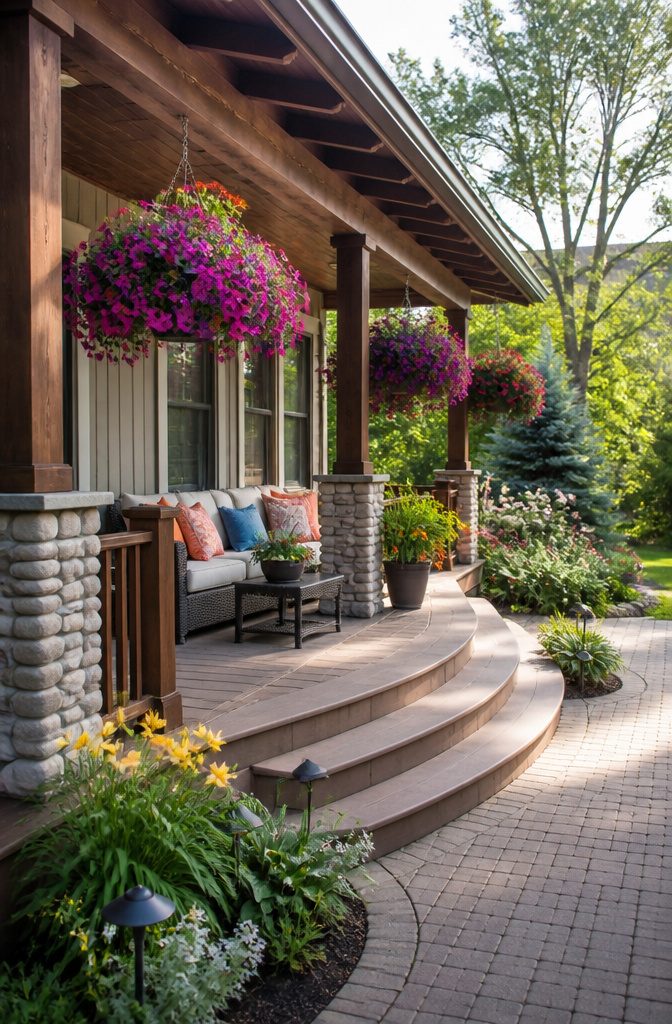
Hanging baskets sit somewhere between a planter and a light fixture, and that dual nature is what makes them tricky. The bracket is the real decision; everything else follows from whether you trust the mount.
For a covered porch, a simple swag hook screwed into the ceiling joist handles ten to fifteen pounds of damp soil and plant without drama.
Exposed locations need a closed-loop bracket, the kind with a retaining wire, because wind will shift a loaded basket into a pendulum.
I have watched a neighbor’s bracket pull paint and all from a fascia board that turned out to be 1/2-inch plywood over hollow framing.
The bracket held; the wood did not. The fix was a backing plate spread to the nearest rafters, which is twenty minutes with a ladder and a drill if you check before you plant.
Watering frequency in open air runs double what the same basket wants under cover. Morning sun plus wind pulls moisture through petunia foliage fast enough that skip a day in July and the basket is crisp by evening.
A drip tray catches the overflow and protects the porch deck below; without one, the stain rings are permanent.
For the spill, Supertunia Vista Bubblegum II trails hard and blooms from late spring to frost, which is the longest window the annual sources give.
Verbena fills the same role with narrower strands. The thriller-filler-spiller formula works here too: one upright stem in the center, two mounders around it, and the trailer pushed to the front rim so it tumbles rather than drapes.
Height is head clearance, plain and simple. I hang mine so the basket bottom sits at 6 foot 6, a hand’s width above my own reach; anyone taller walking up the steps brushes leaves or worse.
If your porch ceiling runs lower, a wall bracket off the door frame keeps the path clear and the plant in sun.
13. Terracotta Planters
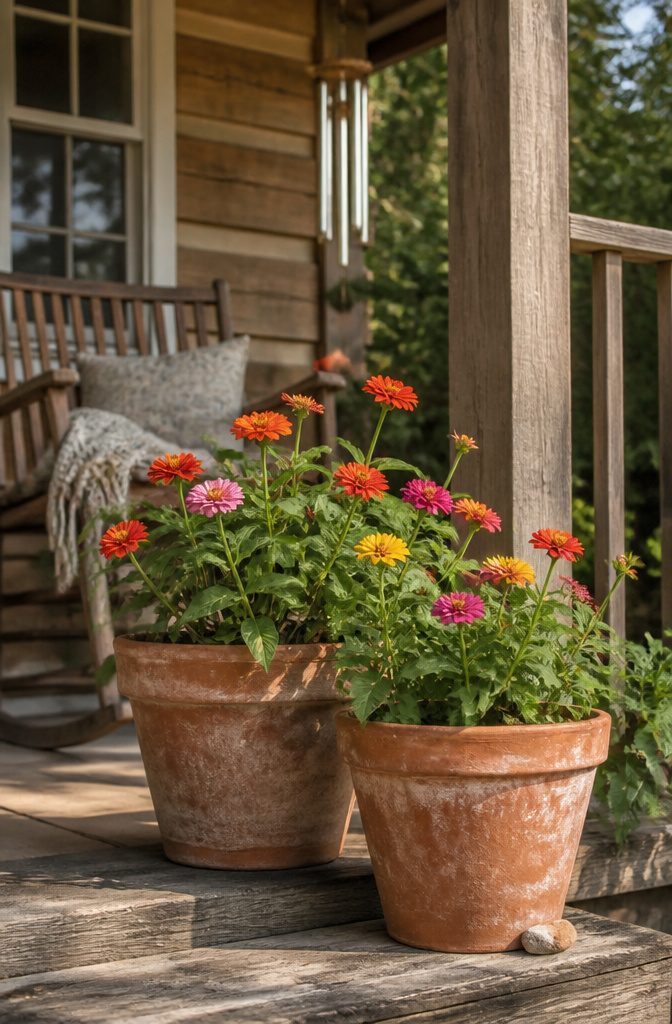
Terracotta breathes in a way plastic never will, and that porosity keeps roots from sitting in water through a humid July.
The flip side shows up the morning after your first hard freeze: unglazed clay pulls moisture in, expands, and cracks along the rim or base.
In zones with real winter, a single season can turn a twenty-dollar pot into a drainage shard. Southerners get years, sometimes a decade, from the same piece left outside year-round.
Weight matters on a front porch you share with a sidewalk. A fourteen-inch terracotta pot empty runs eight to ten pounds, filled closer to thirty, which discourages the casual grab-and-go.
You will want a saucer, though, or the clay leaves a pale ring on painted porch boards that takes sanding to lift.
The warm color works where brick or wood siding already leans orange or red; against cool gray vinyl it can look dropped in from another house.
Unglazed terracotta sits in the $15–40 range for porch-sized pots, and the honest math is two to three years in freeze country versus seven or more where frost is rare.
Glazed versions solve the cracking but lose the breathability and the theft-proof heft, so they belong in a different conversation entirely.
14. Modern Planters
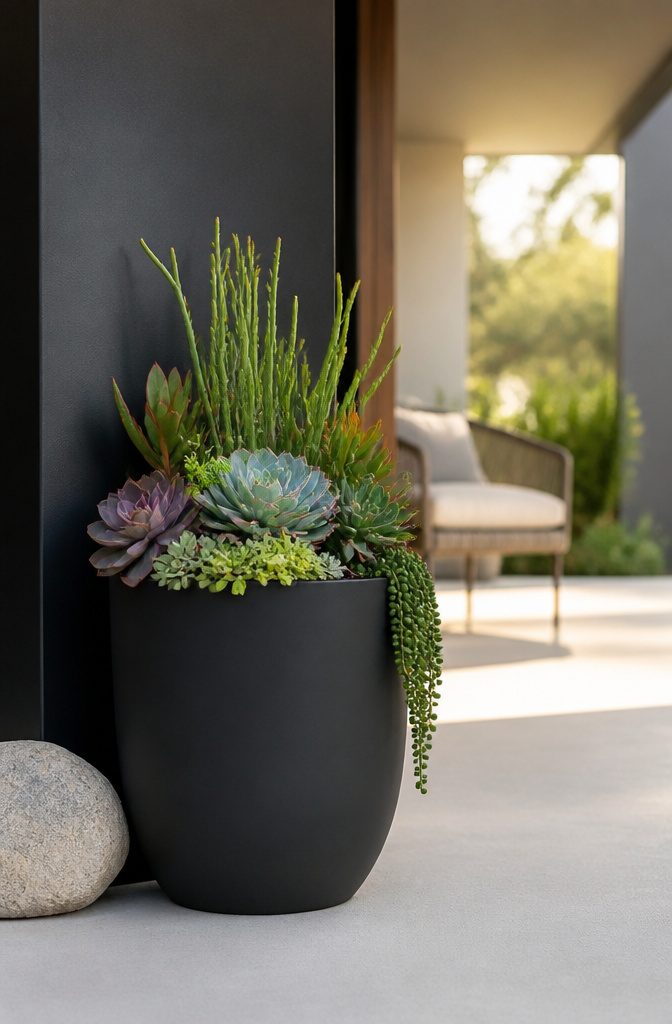
Fiberglass and recycled resin planters are the quiet workhorses of modern front porch planters. The material drops the weight of concrete to something one person can move alone, yet the finish still reads as substantial from the curb.
Matte surfaces hide dust and water spots between waterings; gloss catches morning light and can make a narrow porch feel deeper by throwing back what little sun it gets.
Clean geometry is what separates these from the urn styles. A tapered rectangle or a perfect cube gives the eye nowhere to rest but on the plant itself, which is the point.
I have seen too many porches where an ornate pot competes with a hydrangea and neither wins. The minimal detail solves that.
The recycled resin option, like the My Texas House line, carries the molded look of carved stone without the heft.
Knock-out drainage holes matter more than people think; water pooling in a sealed base rots roots in a single wet season.
Both materials hold exterior-rated finishes now, so the color stays through freeze-thaw cycles that used to chalk cheaper plastics white in two years.
Cost runs from roughly $30 for a 16-inch recycled resin box to $200-plus for a tall fiberglass column.
The break-even is years, not decades, but the lighter weight pays back immediately when you haul them to the garage for a hard freeze.
15. Seasonal Plant Arrangements
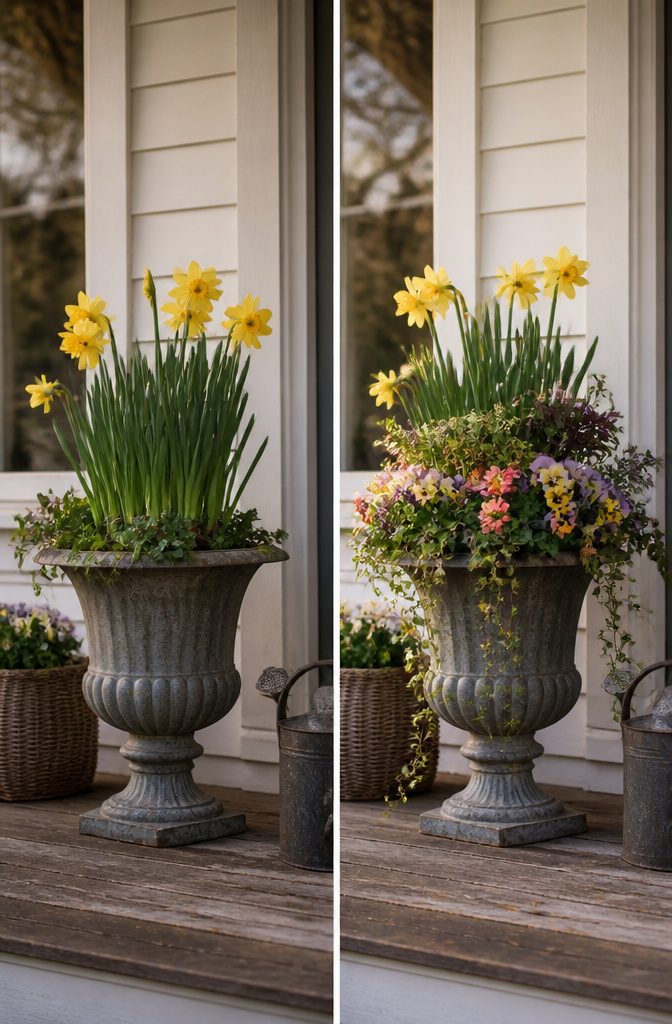
Rotating front porch planters through the year keeps the entry from going stale, but the method matters more than the plant list.
I used to yank everything out each season until I noticed bulbs left in place would push through the summer annuals and give me two waves from one pot.
Now I layer: daffodils and tulips go deepest in fall, then I plant bright summer annuals and trailing spillers over them in late April. The spring show finishes just as the summer growth covers the yellowing bulb foliage.
For fall, mums and ornamental cabbage drop in where the spent annuals were. Winter is where the strategy splits.
Evergreens, pine branches, hellebore, and coral bells handle cold in place, but boxwoods have become my standby for covered porches; they survive winter in their pots if you keep watering weekly, even when it feels wrong to do so.
The ones I leave exposed die back more often than not.
Store empty pots dry and stacked on their sides so freeze-thaw cycles do not crack them.
Clay fractures fastest, resin holds up better. Off-season planters left full of wet soil are heavy, useless, and often broken by March.
16. Vertical Planters
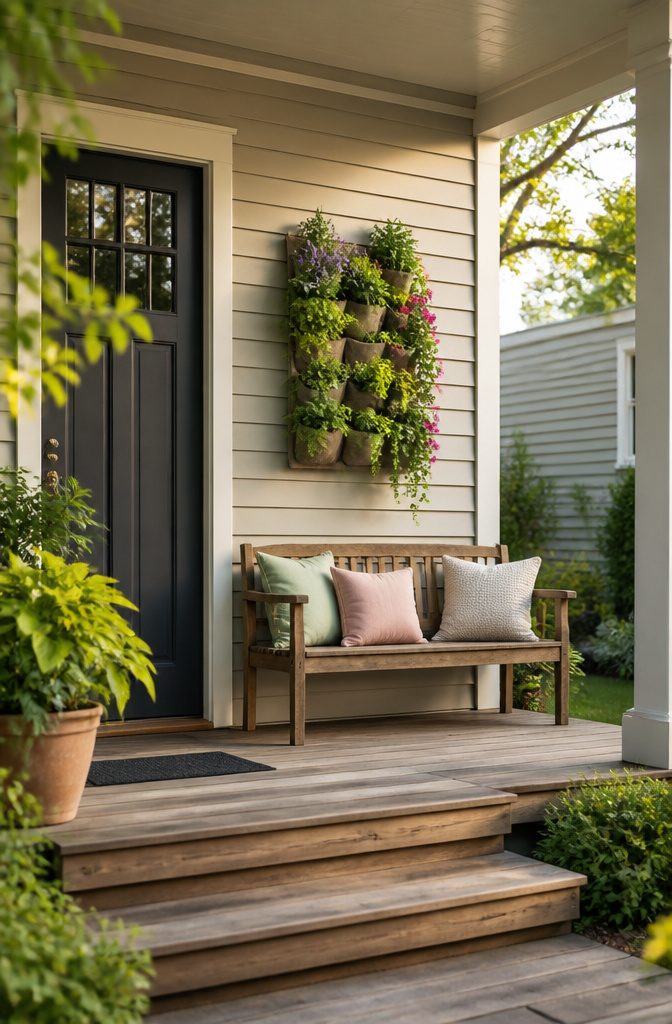
Wall-mounted vertical planters turn a narrow porch into something that reads as intentional, not cramped.
The pocket-style felt or canvas systems that hang in columns of four to six rows work best for renters because they come down in minutes, but the tradeoff is shallow soil.
Roots dry out faster in vertical pockets, so herbs, strawberries, and shallow-rooted annuals like lobelia or alyssum outperform tomatoes or anything that wants to stretch downward.
Watering becomes the job you cannot skip; a drip line threaded behind the pockets saves the wall and the plants, though most people start with a long-spout can and a weekly calendar reminder.
Stacked planters, the kind with tiers of angled openings, give roots more room and hold moisture longer.
The downside is weight. A fully wet stack of three can push past what a standard bracket set wants to handle, so freestanding units on the floor make more sense if the porch has even eighteen inches of depth.
In those, trailing sedum or creeping jenny spills from the lower holes while something upright, like a dwarf coleus, fills the top.
What convinced me, reading through a dozen setups, is that vertical planting fails when people treat it like a horizontal bed tipped sideways.
Gravity pulls water straight through; the bottom pockets stay wettest, the top ones bake. Plant thirstiest varieties low, drought-tolerant ones high, and the whole thing stays alive through August without a rescue mission.
17. Mixed Material Planters
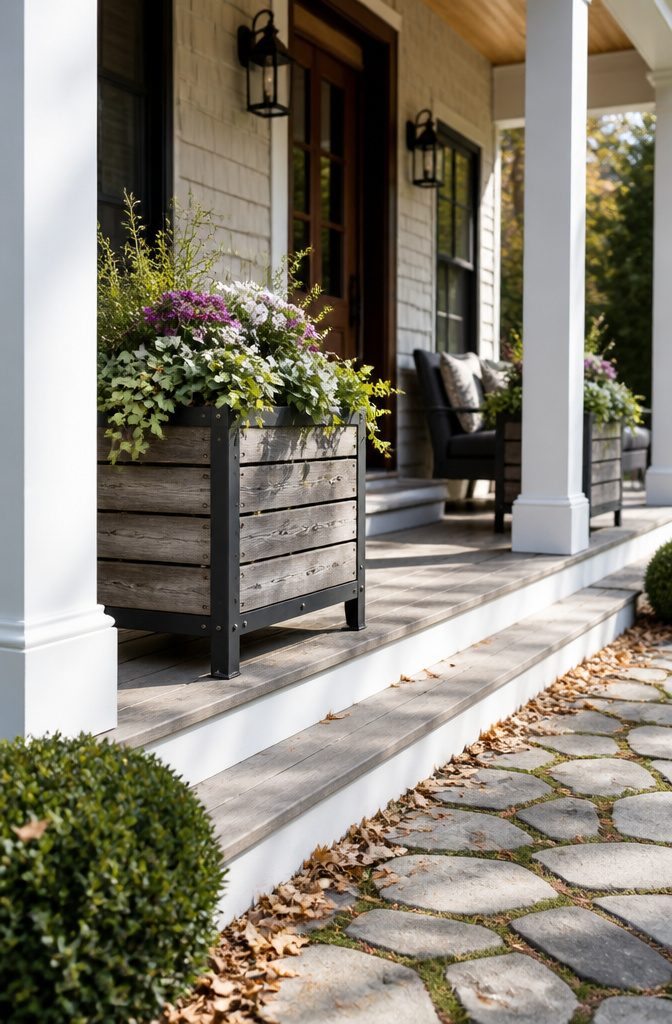
Metal frames with wood inserts or concrete bases paired with timber tops give front porch planters a visual weight that reads clearly from the sidewalk.
The contrast draws the eye without shouting, and the combination often solves a practical problem: the metal or concrete handles weather and soil load while the wood warms up what would otherwise read as cold or industrial.
The failure points are almost always at the joint.
Wood expands and contracts with moisture; metal does not. That gap or buckle you notice after the first hard season usually starts right where the two materials meet.
A planter that hides its fasteners behind a lip or inside a channel lasts longer than one where screws sit flush and exposed.
From twenty feet away, the mixed material reads as intentional architecture rather than a single pot sitting on a step. The eye registers the frame first, then the fill, which is exactly the hierarchy you want for a front porch.
Cheaper versions paint one material to imitate two, and that deception chips fast. Real separation, real fasteners, real maintenance at the seams: that is the trade that holds up.
18. Grand Entryway Planters
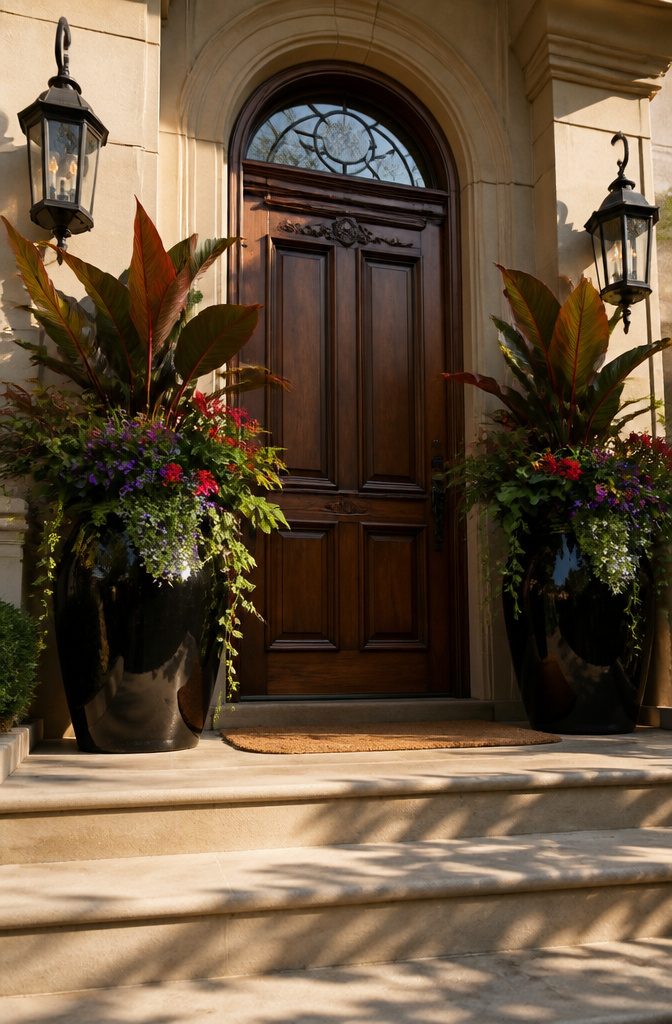
Oversized planters flanking a front door only work when they actually match the door’s height. A pot that disappears beside a tall entry reads as an afterthought; one that overwhelms a low stoop looks like it landed from elsewhere.
The planter should reach roughly one-third to one-half the door height for the frame to feel intentional rather than accidental.
Symmetry is the safe default, and for good reason. Two identical planters with matching plantings create a rhythm that pulls the eye straight to the threshold.
But intentional asymmetry can work if the visual weight balances: a tall, narrow planter on one side paired with a shorter, wider one on the other, both filled to similar density so neither side looks forgotten.
Scale demands scale inside the pot, too.
A single small plant in a 22-inch planter will look marooned. Layering helps: something structural and upright for height, softer material to fill the middle, and a trailing edge to break the pot’s rim.
Boxwoods handle this role in zones 5 through 7, holding their shape in containers through hot summers and cold winters if the pot has drainage.
A 20-inch height by 22-inch width gives enough soil volume for roots to survive without constant watering, though uncovered spots in heavy rain still need that drainage hole to matter.
19. Colorful Flower Arrangements
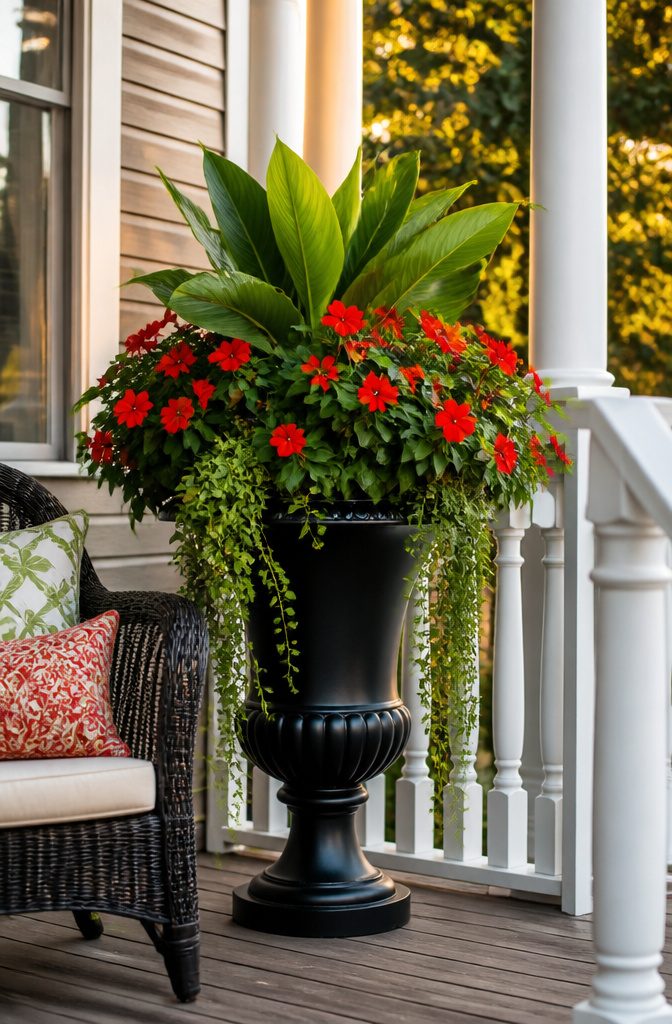
A single oversized urn beats a cluster of small pots every time, and the reason is color control.
One container lets you build a thrill-fill-spill arrangement that reads as a single statement: a tall spiky center for height, bold impatiens packed tight for mass, and trailing lobelia or vines to soften the edge.
The black urn against white siding does half the work; the red flowers do the rest.
Color theory in practice means choosing blooms that carry the same saturation rather than matching hues exactly. Scarlet impatiens and violet trailing torenia clash on paper but sing in shade, where both read as equally intense.
Summer Wave Trailing Large Violet handles the spill layer in partial sun to deep shade, blooming from planting until frost with stems trailing up to 36 inches. That span matters: undershoot the spill and the arrangement looks potted, not planted.
Late spring through frost demands annuals treated as expendable. The urn’s permanent structure stays; the contents rotate once, maybe twice.
My preference runs to combinations that fade gracefully rather than quit all at once. Baby’s breath bridges the gap when early annuals tire, buying time until the next round fills in.
20. Low-Maintenance Planters
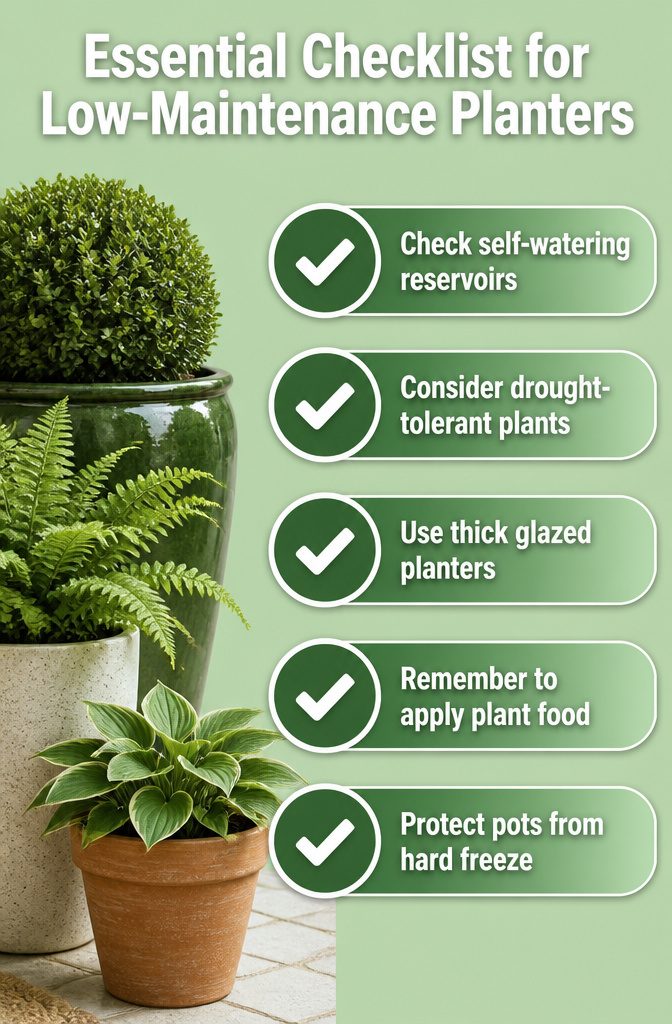
Self-watering reservoirs in front porch planters work only if you actually fill them, a lesson my neighbor’s crispy ferns proved last July. The reservoir buys you maybe a week of forgiveness, not a summer off.
Between those refills, drought-tolerant plants like boxwoods handle skipped waterings far better than the Boston ferns that porch-shade gardeners love; the boxwoods still want weekly drinks even in winter when evaporation slows, and one hard freeze will test any pot left uncovered.
Materials matter as much as plant choice. Plain terracotta wicks moisture away fast enough to turn a reservoir pointless, while thicker glazed or composite walls hold steady.
Ferns and hostas read "virtually maintenance-free" in catalog copy, yet that means shade tolerance and slow spreading, not disappearance from your to-do list.
Every spring still demands fresh plant food to rebuild root strength after winter drain, something the slow-release versions handle for six months if you remember the single application.
Low maintenance, I have learned, means fewer moments of panic, not none; it means planning for the season you will forget, not eliminating the season entirely.
Frequently Asked Questions
What are the best plants for front porch planters?
Ferns, petunias, geraniums, boxwood, and ornamental grasses are reliable choices that handle porch conditions well. The article also highlights angelonia for tall column planters, Supertunia Vista Bubblegum II for hanging baskets, and compact boxwood varieties like Sprinter for year-round structure.
Match the plant to your light conditions: boxwood tolerates sun to shade, while black urns in full sun need heat-tolerant options like succulents.
What are the best low-maintenance porch plants?
Boxwood ranks highest for low maintenance because it adapts to sun or shade without turning patchy, and container growth stays slow enough that repotting is a years-apart task. Ferns, hosta, and coral bells also handle part-shade with minimal attention.
The real shortcut is choosing the right pot: resin and fiberglass need less frequent watering than terracotta, and a 16-inch stone cube holds enough soil to survive a missed Friday.
What is the best plant for a hot sunny porch?
Angelonia sends up tall stems of small orchid-like flowers from late spring through frost and takes full sun without wilting.
Petunias, verbena, and coneflower also thrive in heat. Avoid black urn planters in baking sun unless you are growing succulents; the dark surface absorbs enough warmth to stress roots and dry soil faster than light-colored pots of the same size.