
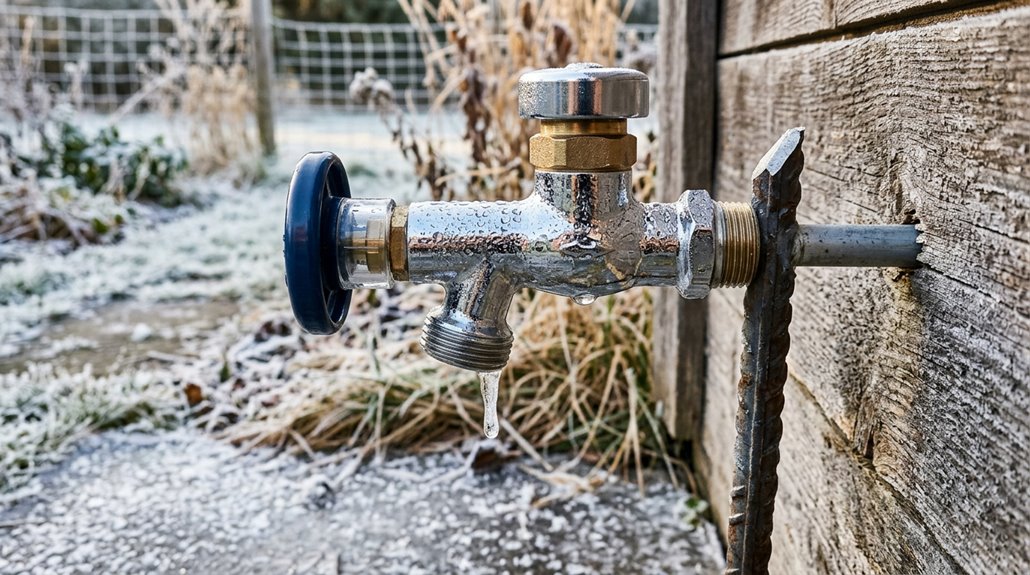
A frost-free faucet relocates your shut-off valve inside where it’s warm, then runs a long stem through your exterior wall to the handle. When you turn it off, water trapped outside drains completely through a sloped pipe, similar to tilting a glass to remove the last drops. No water left behind prevents frozen pipes from cracking and causing winter damage. The slope and drainage must work perfectly, or freezing will still occur.
What Is a Frost-Free Faucet?
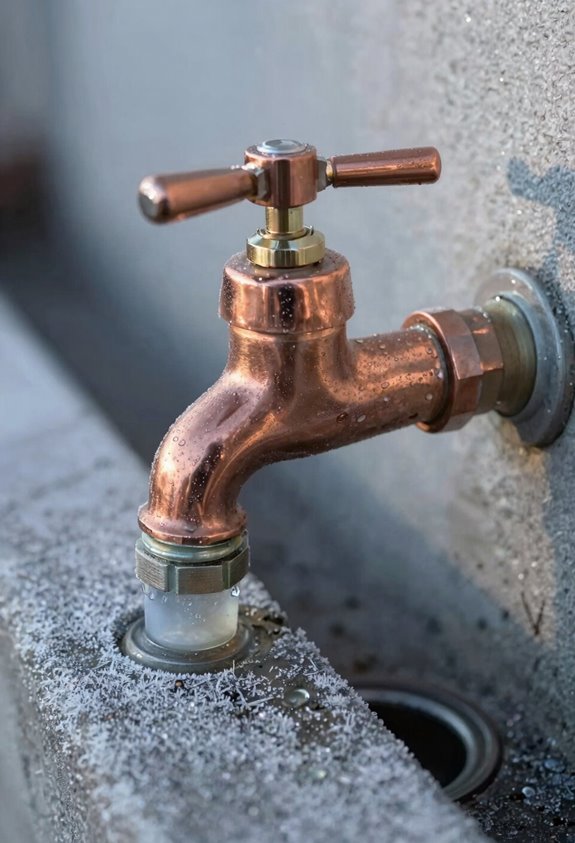
Ever wonder why your outdoor faucet doesn’t explode like a frozen water balloon come January? That’s thanks to a frost-free faucet, basically the genius solution to winter’s plumbing nightmare. Instead of keeping your shut-off valve exposed outside where it’ll freeze solid, engineers tucked it inside your warm house. A long stem then extends through your wall to the exterior handle. When you turn it off, the faucet automatically drains the exterior portion completely. All that water vanishes through gravity-assisted exterior drainage, leaving nothing behind to turn to ice. That downward slope is your pipe’s best friend. No frozen water lingering around means no burst pipes ruining your spring.

【High-quality MATERIALS】The frost free outdoor faucet is made of high quality lead free brass with chrome plated finish to ensure durability and corrosion resistance. The use of lead-free brass has better environmental performance, making the frost-free spigot safe to use for drinking water and plumbing heating water supply.

Sillcock with Standard Outlet Connection – Features a 3/4-inch MHT (male hose thread) outlet for quick, secure hose attachment, ideal for garden watering and outdoor water access.

Frost Free Sillcock: Outside faucet valve features an integrated 1/2 inch PEX end and 3/4 inch garden hose outlet; a shut-off can be found at the inlet of the sillcock to drain the water and provide protection for the valve when freezing.
How the Frost-Free Faucet’s Long Stem Prevents Freezing
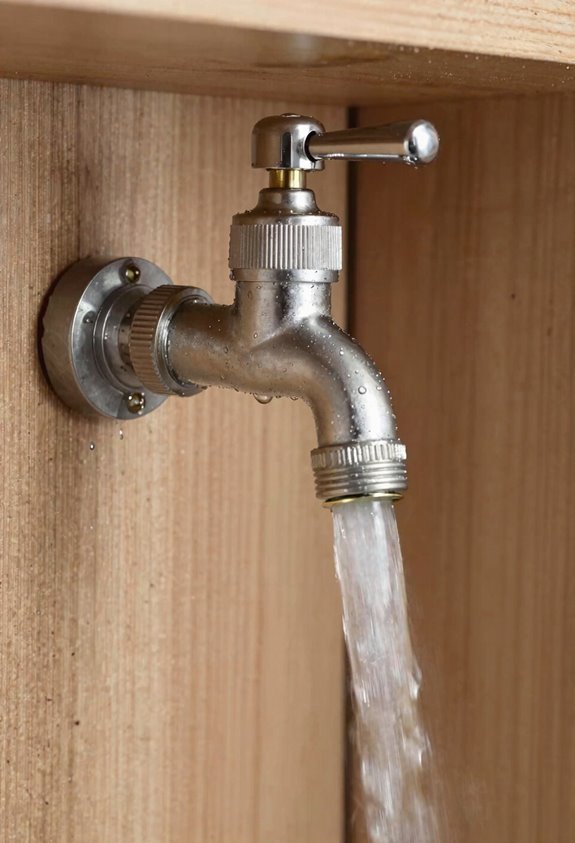
The frost-free faucet’s long stem carries the shut-off valve deep into the heated interior of your walls, keeping freezing temperatures away from the part that controls water flow. When you turn the handle off, the exterior pipe section drains automatically thanks to a downward slope that directs water away from your house. Any remaining water gravity-drains out before it can freeze and expand. The valve stays protected in the warm interior while only the exposed outdoor pipe empties completely, leaving no water behind to freeze when winter arrives.
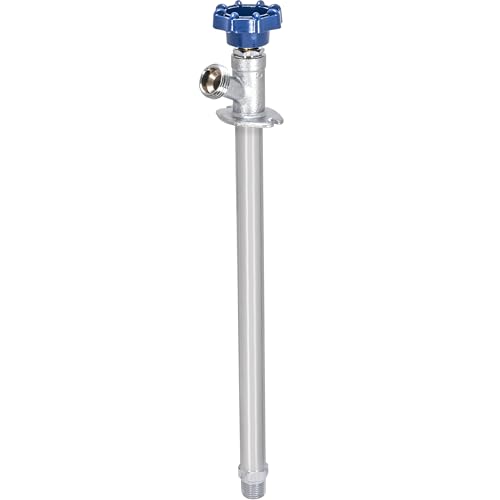
FROST FREE SILLCOCK: Outside faucet valve will provide a source of water to areas of a structure that are subject to freezing; ideal for use with new installation or to replace an existing sillcock

Himaweek Frost Proof Sillcock-Outside faucet valve features an integrated 1/2 inch inlet and 3/4 inch garden hose outlet; a shut-off can be found at the inlet of the sillcock to drain the water and provide protection for the valve when freezing.

Sillcock 3/4-Inch MHT Outlet – Standard 3/4-inch male hose thread outlet for easy attachment to garden hoses, sprinklers, or irrigation systems.
Valve Placement Inside Walls
Since outdoor cold is basically a pipe’s worst enemy, frost-free faucets pull off a clever trick: they move the action indoors.
Valve placement inside your heated interior space matters because:
- The shut-off valve sits tucked away in your wall where warmth keeps it safe
- A long stem extends from that cozy interior valve all the way to your outdoor handle
- Your valve’s sealing components stay dry and protected from freezing temperatures
- When you turn off the faucet, gravity drains the exposed exterior pipe completely
Think of it like moving your most important equipment to a climate-controlled bunker. You’re not leaving anything critical out in the cold where ice can wreck it. This frost-free faucet design keeps your water supply flowing smoothly, even when winter gets brutal. The interior valve placement prevents ice damage that would otherwise stop water flow during freezing conditions.
Drainage Away From Cold
How does water actually escape from a frost-free faucet without freezing solid. When you turn off the handle, the exterior water doesn’t just sit there waiting to become an icy disaster. Instead, it drains away completely.
This frost-free design relies on gravity doing the heavy lifting. The exterior pipe slopes downward, even just slightly, directing water toward the outside. Once you shut the faucet off, that exterior water has nowhere to go but down and out, thanks to the drainage system built into the spout itself.
Think of it like tilting a glass of water toward the edge of a table. The shut-off valve sits inside your warm walls, safely away from freezing temperatures. Meanwhile, the exposed section empties completely. No standing water means no ice formation. No ice means no burst pipes. The water drainage prevents costly structural damage.
Stem Length and Design
Frost-free faucets are the overachievers of outdoor plumbing.
The long stem is the critical component. It performs several essential functions:
- Extends deep into your heated interior space, positioning the interior valve far from freezing temperatures
- Allows water trapped in the exposed exterior portion to drain completely when you turn the handle off
- Keeps the critical shut-off mechanism safely inside where it’s warm and protected
- Requires proper wall depth compatibility so that stem actually reaches where it needs to go
The stem functions as a long passage connecting cold outside to warm inside. Water cannot freeze if it remains stationary, which is the fundamental principle behind frost-free faucet operation.
Where Is the Shut-Off Valve Located?
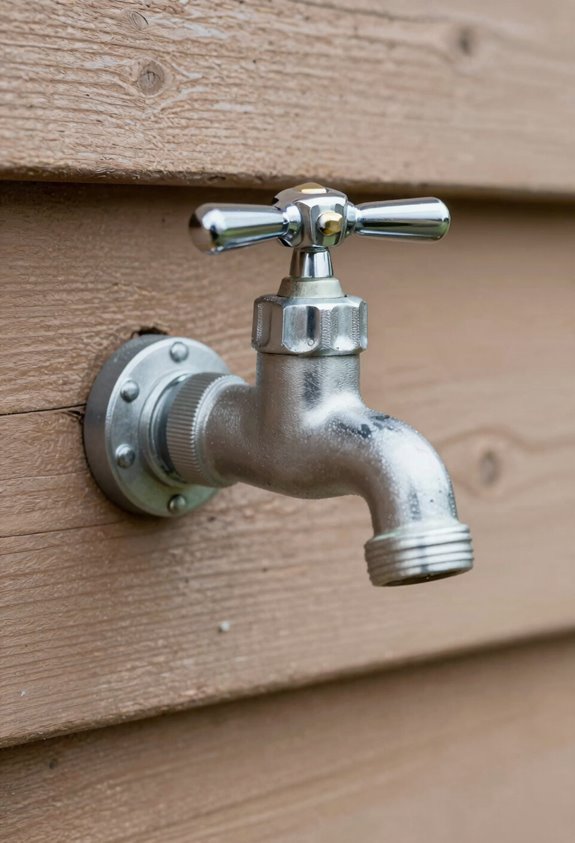
The real advantage of a frost-free faucet is its internal shut-off valve, which is tucked safely inside your warm house rather than exposed to freezing temperatures outdoors.
A long stem connects your exterior handle to that interior valve, bridging the gap between the cold exterior and warm interior. When you turn off the faucet, the drainage mechanism automatically empties the outdoor pipe section completely. No water lingering outside means no ice crystals will form and crack your pipes.
This design keeps freezing conditions away from the valve while the warm interior protects the mechanism. That is how a frost-free faucet prevents freeze damage.

SHARKBITE SILLCOCK REPAIR KIT: This sillcock valve repair kit is compatible with 12 inch frost free sillcocks; Total stem length is 15 inches

Patented Temperature-Activated Design – Automatically activates as water temperature drops below 37°F/3°C, releasing only minimal water to prevent faucets from freezing.
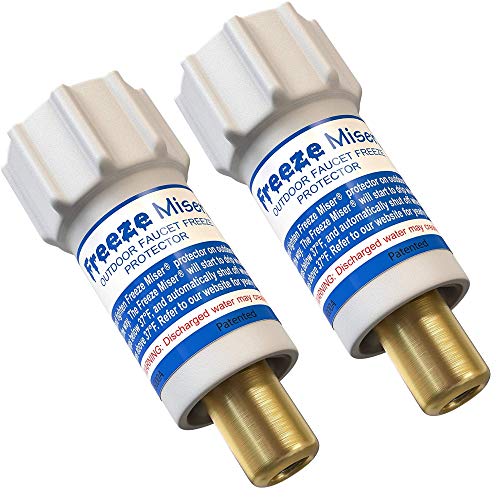
Patented Temperature-Activated Design – Automatically activates as water temperature drops below 37°F/3°C, releasing only minimal water to prevent faucets from freezing.
How Does Water Drain When You Turn It Off?
When you shut off a frost-free faucet, gravity pulls water down and out through the drain path while an interior valve seals tight inside your warm house. The valve stem is positioned so the actual shut-off point sits deep inside where it’s heated, meaning any water trapped in the exposed outdoor section drains out instead of remaining to freeze and cause damage. If your faucet is installed with even a slight downward slope toward the outside, that remaining water flows out completely, leaving nothing behind to turn into an ice blockage that could burst your pipes.
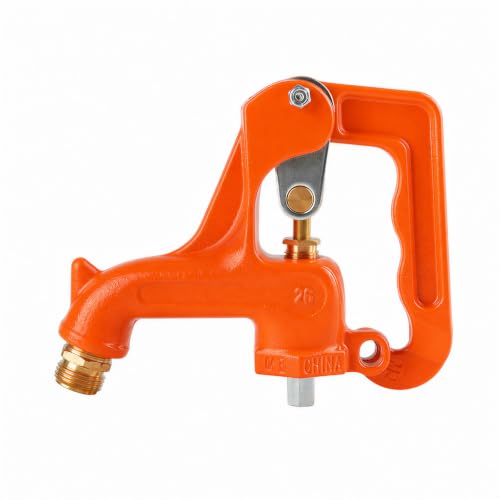
Effortless Connection: Seamlessly integrates with 3/4" hose coupling and 1" NPT galvanized pipe thread, ensuring a secure and frost-free water supply for your yard, garden, or pasture irrigation needs. (Note: Pipe not included)
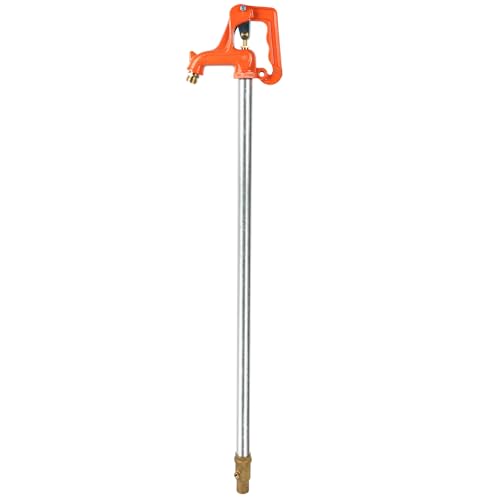
All-Weather Performance: This frost-free yard hydrant ensures a steady water supply, whether it's freezing winter or scorching summer. Perfect for irrigation, drinking water, and equipment cleaning.

Freeze-Proof Performance: Frost-free yard hydrant automatically drains after use to help reduce freezing, ice buildup, and cold-weather pipe damage
Gravity-Assisted Drainage Process
How does all that water actually vanish from your outdoor pipe the moment you shut it off? It’s pure physics, my friend; gravity does the heavy lifting.
Here’s what happens when you turn that handle:
- The shut-off valve, positioned inside your warm house, closes the main water supply
- Residual water in the exposed outdoor pipe naturally flows downward through the sloped interior path
- That water exits through your spout thanks to the continuous downward angle we designed in
- The drained exterior pipe stays empty, so nothing freezes solid overnight
Your frost-free faucet relies entirely on gravity-assisted drainage. That slight slope from valve to spout isn’t decorative; it’s essential. Water can’t pool or linger anywhere because it’s physically impossible. The pipe empties completely, leaving no trapped water to crystallize when temperatures plummet. The design is elegantly simple and functionally effective.
Valve Stem Positioning Details
Gravity does the work, and the real mechanism involves the valve stem positioned inside your warm house. The valve stem is the actual shut-off mechanism, deliberately placed in your heated interior rather than in the freezing outdoors. When you turn the handle off, this internal valve closes, stopping water flow to the exterior pipe. Any water sitting in that exposed outdoor section drains right out through the spout thanks to gravity and the strategic downward slope. The frost-free faucet’s drainage mechanism relies entirely on this positioning. Your long stem ensures the shut-off stays in the warm interior while exterior water evacuates completely. No water trapped in cold pipes means no frozen blockages and no burst faucets.
Water Exit Mechanism Function
The magic of a frost-free faucet really kicks in the moment you shut it off, when gravity becomes your best friend. Here’s what happens next:
- The exterior pipe tilts downward at a careful angle, like a water slide directing liquid toward the exit
- Water flows out through the spout automatically, draining residual moisture that would otherwise freeze solid
- Drainage keeps happening as long as your shut-off valve stays closed, clearing that cold outdoor section completely
- Your pipes stay safe because almost nothing’s left behind to turn to ice and crack everything
The shut-off valve sits way back in your heated interior. This design means the valve stays warm and dry while the exterior pipe empties itself. Gravity does the heavy lifting here; literally no pumps are needed. Physics does the work.
Why Your Frost-Free Faucet Needs a Sloped Pipe
Your outdoor faucet’s angled design serves a critical function. When you turn off the faucet, water naturally drains downward through the sloped exterior pipe and flows out the spout. This drainage prevents water from pooling inside the exposed section, where it would freeze, crack pipes, and damage your entire system.
The slope works with gravity rather than against it. Think of it like tilting a glass to empty the last drops. That angle is the difference between a faucet that survives winter and one that bursts from frozen water expansion. Make sure nothing blocks that drainage path.
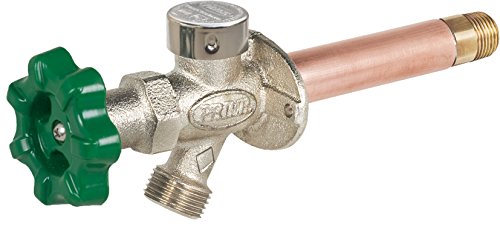
Product is manufactured in United States

Recommended for commercial applications such as office buildings, apartment complexes, malls and shopping centers, schools, churches, and industrial buildings

FROST FREE SILLCOCK: Outside faucet valve will provide a source of water to areas of a structure that are subject to freezing; ideal for use with new installation or to replace an existing sillcock
Frost-Free vs. Regular Hose Bibs: Key Differences
When comparing frost-free faucets to regular hose bibs, you’re looking at two completely different approaches to preventing outdoor water from freezing. Frost-free designs have the valve tucked safely inside your warm house, while regular hose bibs leave water sitting in the exposed pipe where it can freeze and burst.
Frost-free models cost more upfront but save you from wintertime repair expenses. Regular bibs may seem cheaper initially, but January often brings expensive pipe damage that offsets any savings.

Himaweek Frost Proof Sillcock-Outside faucet valve features an integrated 1/2 inch push-fit inlet and 3/4 inch garden hose outlet; a shut-off can be found at the inlet of the sillcock to drain the water and provide protection for the valve when freezing.

Anti-freezing frost proof yard hydrant:No worrying outdoor freezing pipes and faucets in winter cold freeze temperatures,just turn on the outdoor tap in any time for normal use water.Our frost free outdoor faucet will keep the outdoor water hydrant from freezing,provides a steady stream of water supply.

Keep Water Flowing: Our 3.25FT frost-proof yard hydrant, with 12" bury depth, adapts to frost lines in various regions and effectively prevents pipes and faucets freezing. Featuring 3/4" NH hose coupling and 3/4" NPT pipe connection, it's easy to install, perfect for watering garden, washing car, or farm irrigation.
Design and Valve Placement
Why do frost-free faucets seem to have their guts installed inside your house while regular hose bibs just hang out on the exterior wall like they’re inviting trouble?
Valve placement makes all the difference. In a frost-free design, the magic happens indoors where it’s warm.
- The valve sits deep inside your heated space, tucked away from freezing temperatures
- A long stem extends outside. Water drains completely when you shut it off
- Regular hose bibs have their valve exposed outdoors, which invites frozen pipes
- The supply pipe angles downward intentionally, letting gravity handle the drainage mechanism naturally
This frost-free design approach eliminates winter pipe freeze risks. The exposed section empties itself automatically. No water lingering outside means no burst pipes. The engineering prevents water retention that would otherwise freeze and damage your plumbing.
Winter Maintenance Requirements
Now that you understand how frost-free faucets keep their valves tucked safely indoors, you can see the practical advantage: they require significantly less maintenance during winter. Unlike regular hose bibs that demand draining, unhooking hoses, and wrapping them for protection, frost-free designs handle this automatically. A proper frost-free design drains water through gravity when you turn it off. Your responsibility is to ensure that downward slope toward the exterior remains clear, with no obstructions blocking the drainage path.
Meanwhile, your neighbors with regular bibs must winterize by draining, insulating, and removing hoses each season. This winter maintenance difference makes frost-free faucets a practical investment for cold climates.
What’s Inside a Frost-Free Faucet: The Parts That Matter
it’s basically a magic trick played on winter itself. Walk through the clever parts that keep your outdoor water flowing when temperatures drop.
The genius lies in these key components:
- Long interior stem – This extends deep into your heated house, positioning the frost-free valve where warmth protects it
- Interior shut-off valve – Located safely inside, it controls water flow from a toasty spot
- EPDM washers – These cold-resistant seals stay flexible even when it’s brutally freezing outside
- Vacuum breaker – This protects your drinking water from backflow contamination
When you turn that exterior handle, you’re remotely operating the valve inside. After shutting off, water drains automatically from the exposed pipe. This prevents ice buildup and burst pipes, providing reliable winter protection.

【All-Season Freeze Protection】This 12 inch frost free sillcock prevents frozen pipes and bursting in winter by draining water automatically when closed. Its anti-siphon vacuum breaker blocks backflow, keeping water clean and contaminant-free year-round.

Versatile Compatibility: Featuring a 1/2-inch push-fit inlet and 3/4-inch garden hose outlet, the frost-free sillcock is compatible with copper, PEX, CPVC, and more pipes.

【Function】This freeze proof outdoor faucet effectively prevent freezing and bursting, to prevent any water from being siphoned back into your water supply, keeping your pipe safe from freezing in cold weather. It also has a stem to provide enough amount of room to keep the pipe protected.
How to Install a Frost-Free Faucet: The 3 Must-Follow Rules
Ready to keep your outdoor faucet from turning into an expensive ice sculpture. Follow these three essential rules.
First, slope that pipe downward, not just “close enough.” Even a quarter-inch drop per foot matters because gravity facilitates drainage. Second, choose a frost-free model that fits your wall depth; measure twice, buy once. Third, seal everything. Apply exterior sealant at joints and Teflon tape on threads, since water sneaking behind your installation defeats the entire purpose.
Proper installation ensures your frost-free faucet actually works. Shut off your indoor supply before starting and follow local codes for anti-siphon requirements.

For anti-siphon, frost-free Sillcock
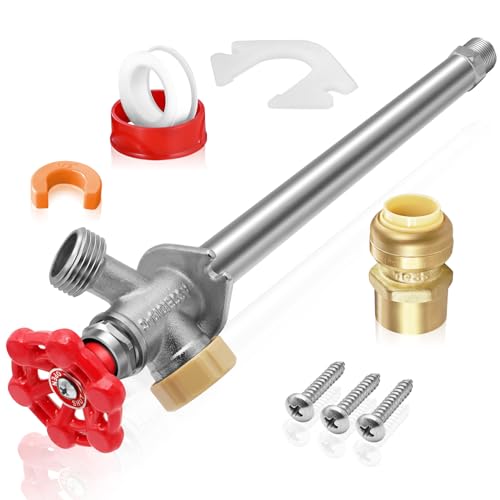
【Material】The frost free outdoor faucet is crafted from high-quality lead-free brass, chrome plated, ensuring durability and resistance to corrosion. The use of lead-free brass, making the frost free sillcock safe for potable water applications.

Smart Auto-Thermal Anti-Freeze System – Features a built-in temperature sensor activating at ≤37°F/3°C, adjusting water flow: slight dripping at 33.8–37°F (1–3°C) and full flow below 33.8°F/1°C. Shuts off above 37°F/3°C to save water—no monitoring, delivering reliable freeze protection for outdoor faucet.
Common Installation Mistakes That Cause Freezing
Frost-free faucets fail when installed incorrectly, turning into ice sculptures during winter despite their intended purpose.
Common installation errors include:
- Improper drainage slope. If your exterior pipe doesn’t angle downward toward the outside, water pools there and freezes solid.
- Wrong valve placement. Installing your interior shut-off too close to heated space means water behind it still freezes solid.
- Skipping frost-free models. Using regular hose bibs in cold climates causes burst pipes.
- Forgetting to drain. Leaving water sitting in the exterior line after shutdown causes ice damage.
These mistakes are fixable with proper attention to drainage angle, valve location, and winterization procedures.

Frost proof yard hydrant working principle: When shut off the frost proof outdoor faucet, the underground valve will open a small drain hole for draining out all the water stored in the pipe to prevent the hydrant from freezing. So don't worry the hydrant leaking when shut off, and when turn on the hydrant, the underground valve will be closed.

Frost-free yard hydrant, made of lead-free material, 3.25ft total length, 12" burial depth, 3/4" NPT garden hose connection, no leaks, fast drainage, smooth and easy to control valve action
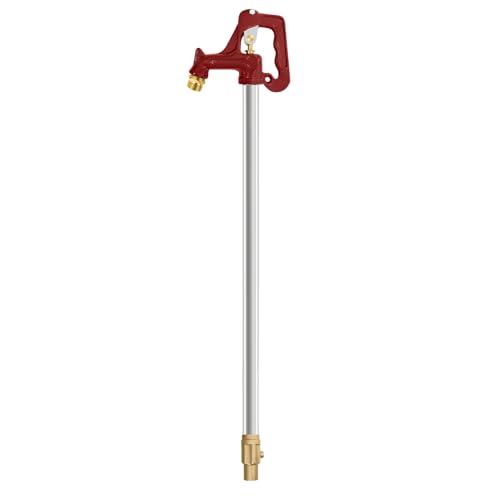
Frost proof yard hydrant working principle: When shut off the frost free outdoor faucet, the underground valve will open a small drain hole for draining out all the water stored in the pipe to prevent the hydrant from freezing. So don't worry the hydrant leaking when shut off, and when turn on the hydrant, the underground valve will be closed.
Why Your Frost-Free Faucet Leaks (and How to Fix It)
Even the best frost-free faucet can betray you with an annoying drip-drip-drip when you least expect it. I’ve been there, frustrated and confused. Worn internal parts like washers and O-rings are usually the culprits, slowly leaking even when shut off. But that’s not always your villain.
| Problem | What Happens |
|---|---|
| Worn washers | Water seeps past closed valve |
| Blocked drainage | Debris traps water in pipes |
| Poor slope | Residual water freezes inside |
| Sediment buildup | Connections leak and crack |
| Faulty stem | Valve won’t seal properly |
Think of it like a dam with tiny cracks. You’ll need to replace those worn parts and ensure your drainage slopes properly, about ¼ inch per foot downward. Clean out any sediment blocking that drain path. These fixes restore your frost-free faucet’s performance.
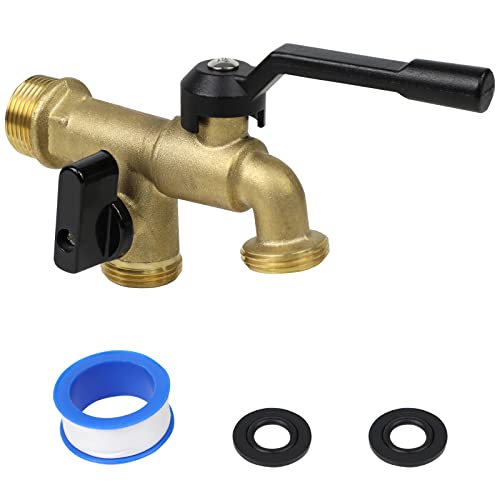
【2 in 1 Double Faucets Water Tap】Our double faucets split 1 spigot into 2 outlets, external tap standard 3/4 inch inlet and 2 x 3/4 inch outlets can connect two hose distributors at the same time. It can meet your more water needs without splitter.

FROST FREE SILLCOCK: Outside faucet valve will provide a source of water to areas of a structure that are subject to freezing; ideal for use with new installation or to replace an existing sillcock

【Function】This freeze proof outdoor faucet effectively prevent freezing and bursting, to prevent any water from being siphoned back into your water supply, keeping your pipe safe from freezing in cold weather. It also has a stem to provide enough amount of room to keep the pipe protected.
Annual Frost-Free Faucet Maintenance Checklist
Once you’ve patched up those leaks and got your faucet running smoothly again, the priority is preventing the same situation next winter.
Staying ahead of problems is more effective than dealing with emergencies during a freeze. This frost-free faucet maintenance checklist addresses the essential tasks:
- Inspect hose connections for drips or moisture buildup every month
- Check drainage paths to ensure water flows freely toward the exterior with that essential downward slope
- Replace worn washers or O-rings at the first sign of wear; don’t wait
- Lubricate your handle and stem annually to keep everything moving smoothly
These simple tasks take maybe thirty minutes total, but they’ll save you hundreds in repairs. When January arrives without a crisis, you’ll have avoided costly emergency repairs.
Do Frost-Free Faucets Work in Extreme Cold?
How well do frost-free faucets actually hold up when temperatures plummet to 20, 10, or even 0 degrees below zero? They’re tough performers, but they have limits. Your frost-free faucet works effectively in normal winter conditions because drainage happens automatically. However, extreme cold demands respect. Ensure your faucet model matches your wall depth and pipe size precisely; mismatches create pockets where water lingers and freezes despite the drainage system. Consider adding vacuum breakers or drain-and-fill options for additional protection. Frost-free faucets prevent freezing in standard winters, but extreme cold may require backup plans. They’re reliable, yet even the best performers benefit from additional measures when temperatures become severe.
When to Replace Your Frost-Free Faucet
Why does your frost-free faucet keep dripping like a leaky conscience even after you’ve turned the handle off? It’s time to replace it. Look for these warning signs:
Why does your frost-free faucet keep dripping like a leaky conscience? It’s time to replace it.
- Constant dripping persists after shutting off the handle, wasting water and increasing your utility bills
- The exterior pipe refuses to drain properly, leaving standing water that’ll freeze solid
- Missing or worn internal components like washers or O-rings cause leaking issues
- Recurring frost damage keeps happening despite having a frost-free model installed
If you’re seeing these signs, don’t wait around hoping things improve. A replacement frost-free faucet prevents burst pipes and costly repairs. Upgrading now avoids water damage and expensive emergency plumbing services later.