

Snake plants grow from pup to 9 feet tall in conditions that kill most houseplants, but nearly everyone overwaters them.
Let the top 2 to 3 inches of soil dry completely between waterings, then water until it drains. Variegated types lose their stripes when propagated from leaf cuttings because the color sits in the rhizome, not the leaf tissue.
1. Choose a Growing Spot

Snake plants prefer bright, indirect light, but they are famously forgiving if that is not what you have. A spot about 10 feet from a west or south-facing window gives them the medium light where they grow most actively.
Lower light slows growth and can fade the variegation on patterned varieties, but the plant will hold on without complaint. Artificial light, medium light, and even a dim corner all work.
The one place that does not work is direct sun.
Hot afternoon beams through a south or west window will scorch the leaves quickly. If the plant sits close to a bright window, use a sheer curtain to diffuse the light.
Darker-leaved varieties handle low light better than variegated ones.
A solid green Dracaena trifasciata or Dracaena hahnii jade keeps its color in shade, while a snake plant striped with white or yellow will slowly revert to green as it puts out new growth.
2. Plant in Suitable Soil and a Pot
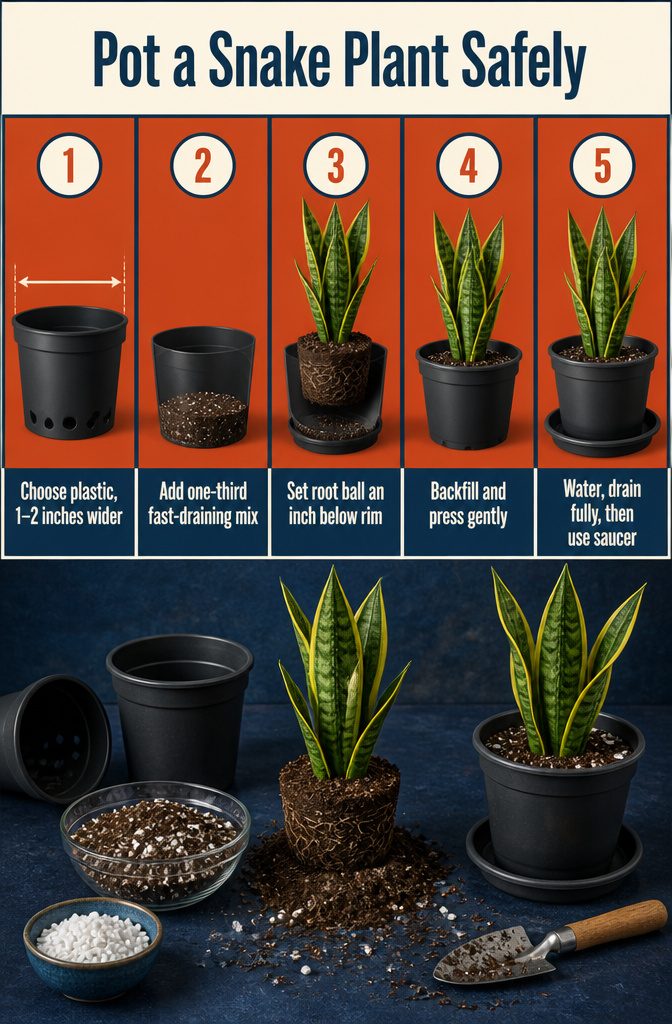
- Pick a plastic pot with drainage holes that’s 1–2 inches wider in diameter than the root ball. Plastic wins over terracotta because snake plant roots grow aggressively enough to crack ceramic.
- Fill the container about one-third full with a fast-draining mix. I use cactus or succulent mix, sometimes blended with potting soil at a 1:1 ratio. If the mix feels heavy or the pot has only a couple of small drain holes, add a few handfuls of perlite or sand to speed drainage.
- Remove the plant from its current pot and set the root ball in the new container, positioned about an inch below the rim to leave room for watering.
- Fill in around the root ball with more soil and press gently to settle it.
- Water thoroughly, let it drain completely, then set the pot on a saucer. Snake plants store water in their leaves and roots, so sitting in pooled water damages them fast.
3. Water Only After the Soil Dries
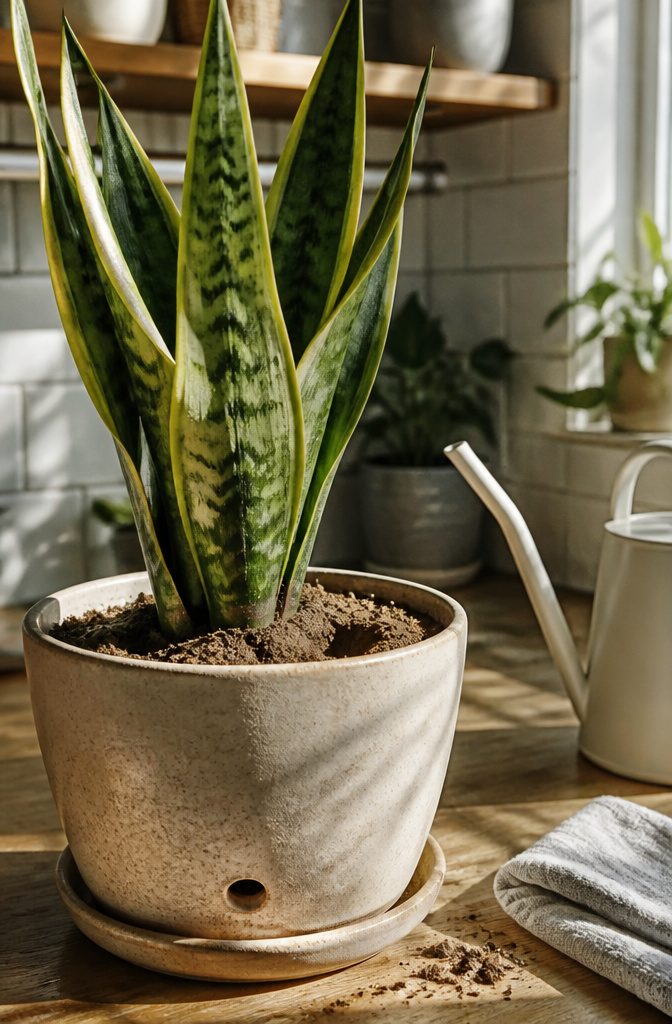
Let the soil dry completely between waterings, then water thoroughly until it drains from the bottom. Check the top two to three inches with your finger—if it feels dry, it’s time.
Thirty minutes after watering, empty the saucer. Snake plant roots rot when they sit in standing water, and the damage happens faster than you’d expect.
Make sure you let the water drain away fully – do not let the plant sit in water as this may cause the roots to rot.
That means your saucer stays dry most of the time, not just when you remember to check it.
Watering frequency depends on pot size and season.
A large pot in winter might go five to seven weeks between waterings. A small 4-inch pot in summer needs water every two weeks, stretching to two or three weeks in winter when growth slows.
Most snake plants fall somewhere in the two-to-eight-week range. Skip the calendar and trust the finger test instead.
4. Feed During Active Growth
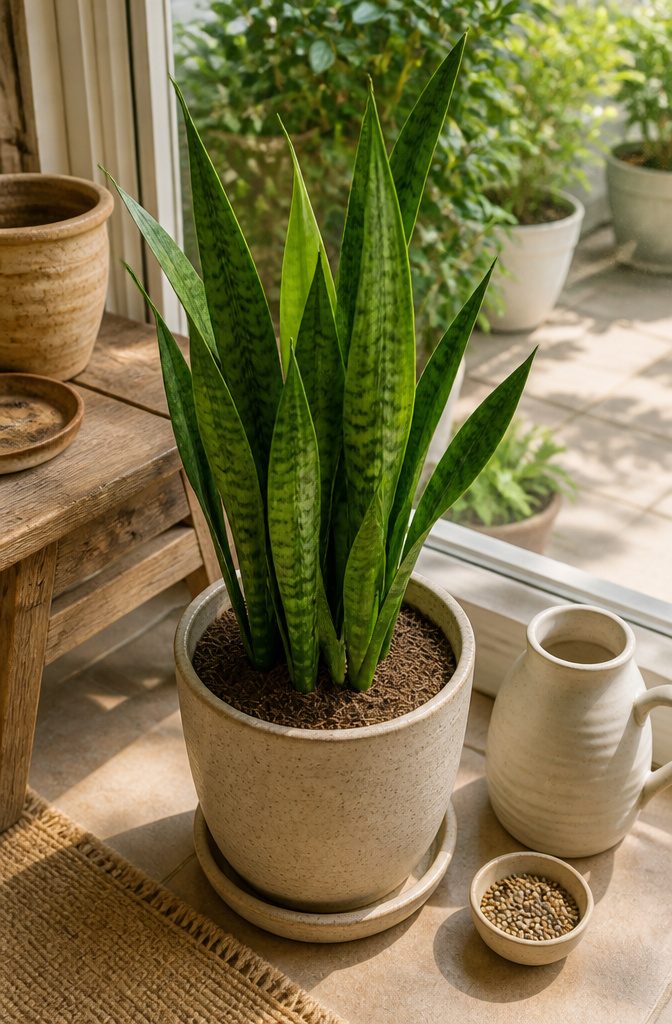
Snake plants are light feeders, and timing matters more than frequency.
Feed once in spring and again in mid-summer with a balanced houseplant fertilizer diluted to half strength. Monthly feeding from April through September works too, though weekly application during the growing season is the aggressive end of the range.
One grower in Tucson with a long season applied fertilizer seven times from mid-February through October, alternating granular and liquid types, and topped the soil with a quarter-inch each of worm compost and compost every couple of springs for a six-inch pot.
Stop feeding in fall and winter when growth slows.
Too much fertilizer builds up salts that burn roots and show as brown leaf spots, and a snake plant that gets more than it needs suffers more than one that gets less.
Skip feeding any plant that is bone dry or soaking wet.
5. Maintain and Watch for Problems
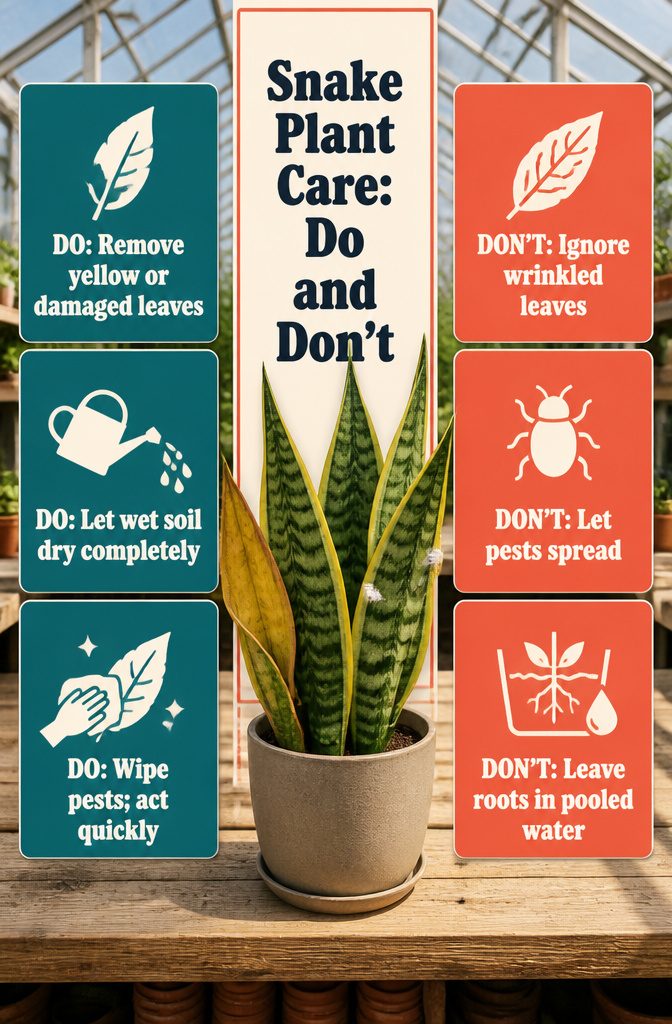
Snake plants rarely ask for much, but it pays to check in occasionally and catch trouble while it’s still small.
Remove any yellow or badly damaged leaves by cutting them off near the base; yellowing usually points to overwatering or root rot taking hold, so pull back on water and let the soil dry out completely before the next round.
Wrinkled, puckered leaves mean the opposite: the plant is using up the moisture in its tissue faster than you’re replacing it, so water thoroughly and check again in a few days.
Leaves that lean or fall sideways can reflect watering gone wrong in either direction, not enough light, or a pot that’s too loose around the roots. Taller, older leaves sometimes collapse on their own without warning.
Pests are uncommon but worth watching for. Mealybugs show up as white, fluffy blobs on the undersides of leaves; spider mites and scale insects may also appear, often signaled by discolored or sticky foliage.
Wipe mealybugs off with a damp cloth or treat with insecticidal soap or neem oil following the label. Act quickly when you spot any pest, since they spread fast from plant to plant.
6. Repot When Needed
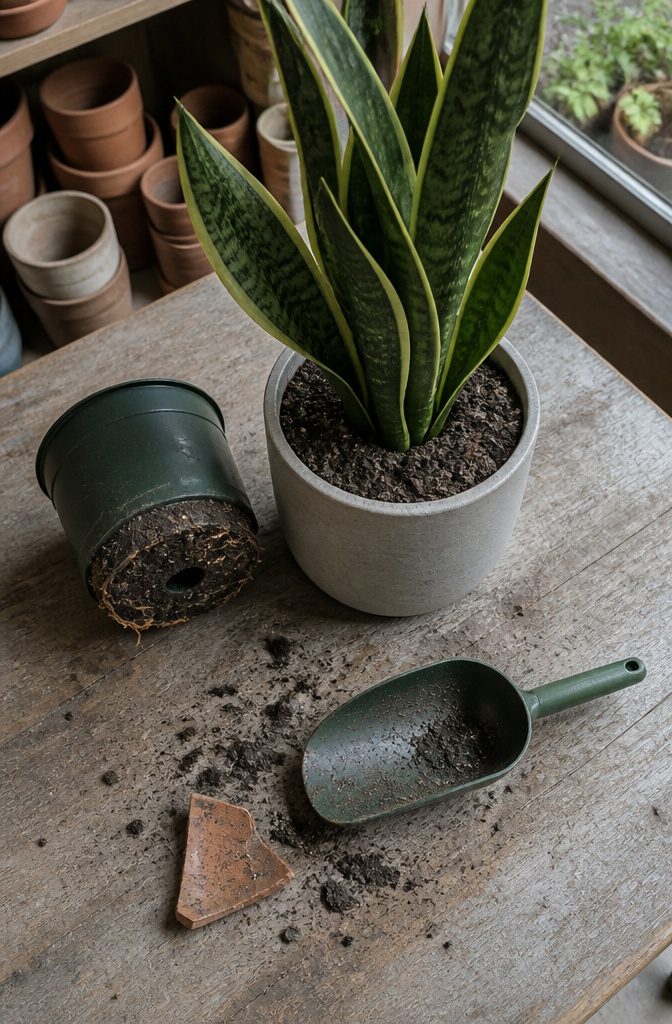
Snake plants tolerate being pot-bound and grow slowly in that state, so you can leave yours undisturbed for years.
Repot when roots push out the drainage holes or when the plant clearly outgrows its container. Spring is the best time to move it.
How often depends on growth rate. A plant in bright light with regular feeding may need a new pot every two to five years.
One in low light, barely growing, can stay put for five to ten years. Even when the roots have room, fresh soil after a few years gives the plant something to work with.
Choose a pot one to two inches larger in diameter than the current one. Going bigger invites soggy soil the roots cannot use.
Make sure the new pot drains, and use the same well-draining mix you planted in originally. If your snake plant is tall and top-heavy, a heavier pot keeps it upright.
7. Propagate to Make New Plants
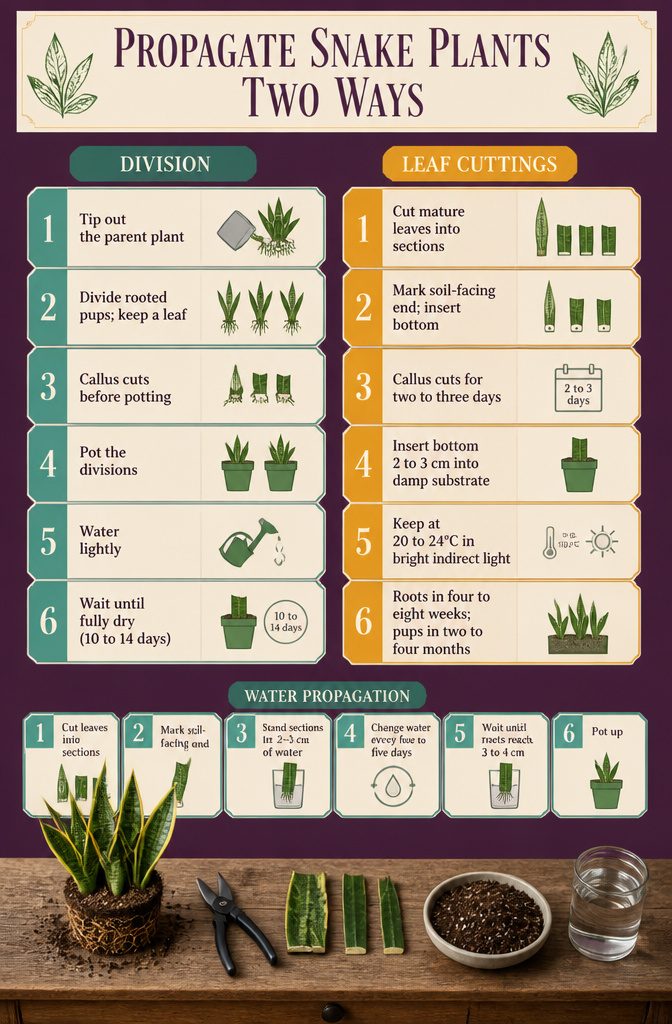
Division gives you rooted plants in four to six weeks and keeps variegated patterns intact. Leaf cuttings take longer but let you multiply one healthy leaf into several new plants.
For division, tip the parent plant out and look for the thick horizontal rhizomes connecting each leaf cluster.
Cut between groups where a pup has its own roots, leaving each division with at least one leaf and a section of root.
Let the cut surfaces callus for 24 hours before potting. Water lightly, then wait until the substrate is fully dry—usually 10 to 14 days—before watering again.
Leaf cuttings work best for plain green varieties.
Cut a mature leaf into sections 7 to 10 cm long and mark which end faced the soil, since roots only form from that end. Callus the cuts for two to three days, then insert the bottom 2 to 3 cm into damp substrate.
Keep it at 20 to 24°C in bright indirect light. Roots form in four to eight weeks, and new pups push up around the original leaf in two to four months.
Water propagation is another route: stand sections in 2 to 3 cm of water, change it every four to five days, and pot up when roots reach 3 to 4 cm.
Temperature and Humidity
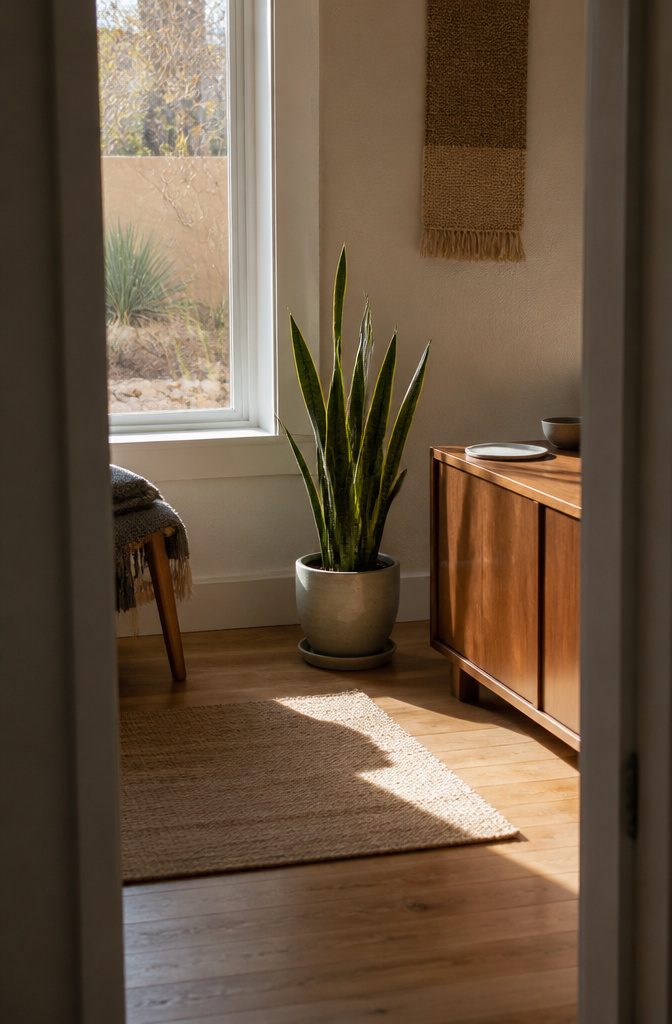
Snake plants handle standard indoor temperatures of 70–90°F without complaint. They can drop as low as 50°F and keep going, though I wouldn’t park one next to a drafty window in January.
I’ve seen them survive Tucson summers that hit 110°F, but winter frost is the line: get them inside before temperatures drop that far.
Humidity matters less than you’d expect. These plants prefer a dry environment and do fine in the stale air most homes run in winter.
A bathroom works, a desert climate works, average household levels work. Skip humid conditions if you can — they tolerate them, but drier is better.
Why Variegation May Disappear in Propagation
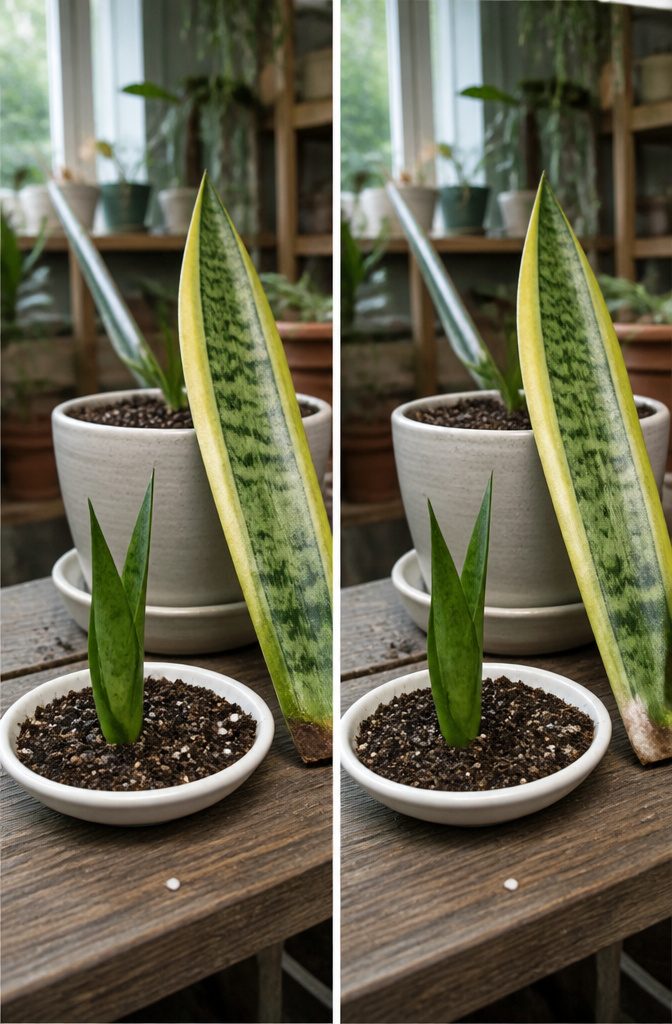
If you propagate a variegated snake plant like ‘Laurentii’ or ‘Star Canary’ from a leaf cutting, the new plant will come up plain green. The yellow or silver edges do not carry through.
The variegation sits in a single cell layer that only the rhizome holds reliably; leaf tissue regenerates from cells without that marking, so the pups push up solid green no matter how pretty the parent leaf was.
Sansevieria cylindrica behaves the same way. A cutting from a variegated cylindrical snake plant loses its pattern in the next generation.
Division is the method that keeps variegation intact, because you are moving a piece of the rhizome rather than coaxing new growth from leaf tissue alone. If the colour is the reason you bought the plant, divide rather than cut.
Height and Pot Sizes
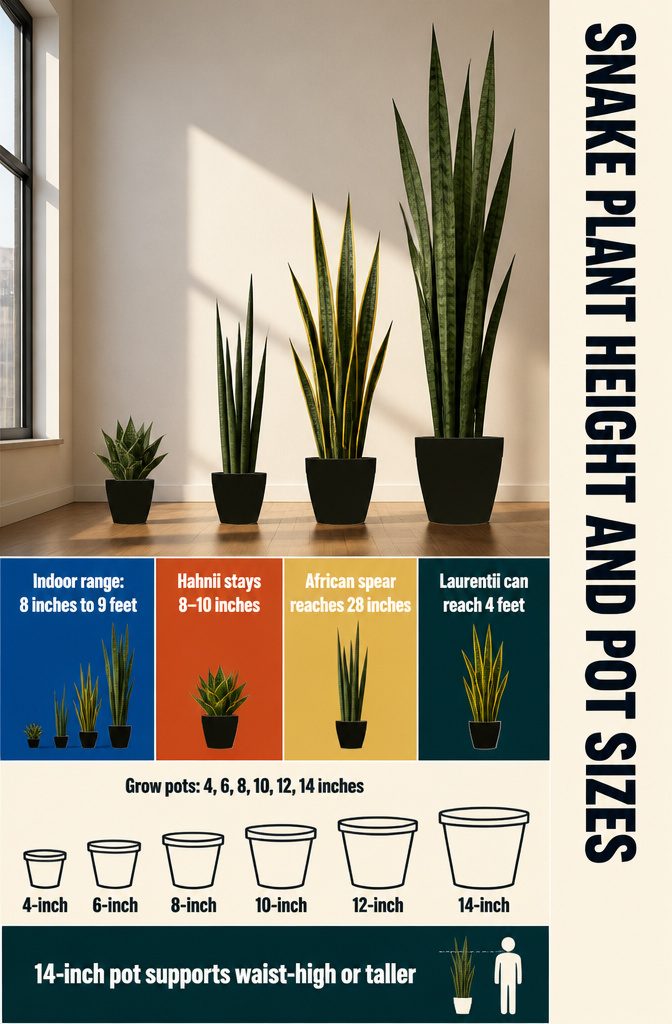
Snake plants grown indoors range from 8 inches to 9 feet tall, depending on the variety you pick. The compact bird’s nest type, Sansevieria trifasciata ‘Hahnii’, stays around 8 to 10 inches.
The common yellow-edged Laurentii can reach 4 feet, and the cylindrical African spear type grows to about 28 inches. I’ve seen Zeylanica push past 5 feet when given time and space.
Nurseries sell them in 4, 6, 8, 10, 12, and 14-inch grow pots, and the pot size roughly tracks with mature height: a 4-inch pot holds a young plant that may top out at a foot, while a 14-inch pot supports one that will eventually stand waist-high or taller.
Flowers, Toxicity, and Air Quality
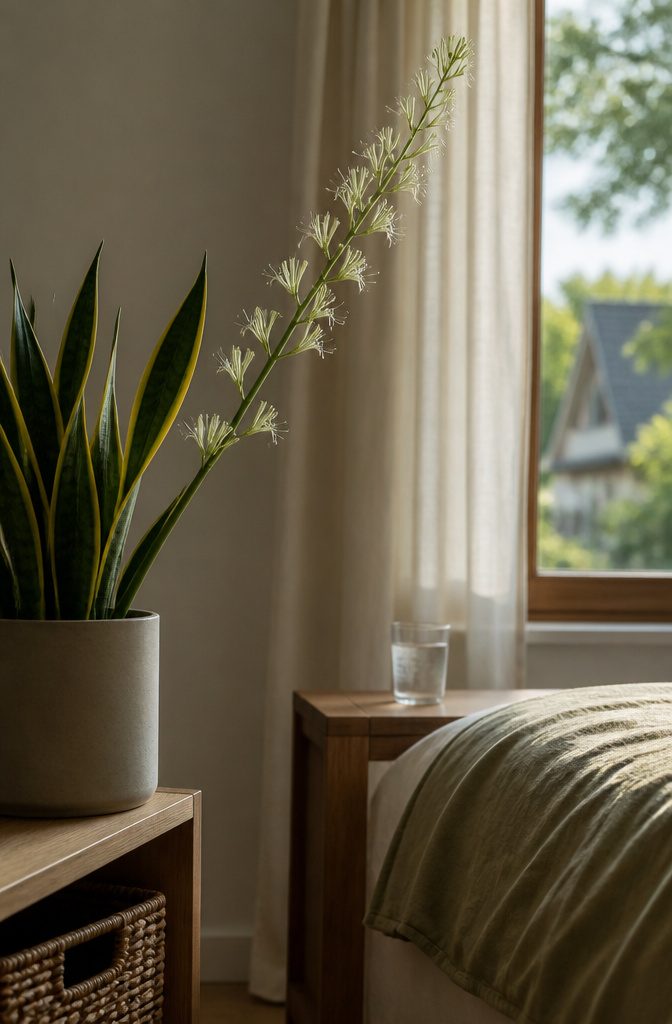
Snake plants can produce flowers indoors, though the timing is unpredictable and the event itself is rare.
The blooms are pale whitish-green and sweetly scented, appearing more readily on some varieties than others. One plant might flower almost yearly while another in the same space never does.
The plant is mildly toxic to cats and dogs. The leaves are tough and fibrous, which seems to make them less appealing to pets than softer houseplants, but the ASPCA lists them as problematic if chewed.
If you have animals that sample greenery, keep the plant out of reach or choose something safer.
Snake plants are also credited with air-purifying ability. They filter indoor toxins and release oxygen at night, which has led to recommendations for bedroom placement.
These qualities matter if air quality drives your plant choices, but they sit outside the core work of keeping the plant alive and growing.
Frequently Asked Questions
How often should I water my snake plant?
Water only after the soil dries completely, checking the top 2 to 3 inches with your finger.
Most snake plants need water every 2 to 8 weeks depending on pot size, season, and light levels. A small 4-inch pot in summer may need watering every 2 weeks, while a large pot in winter can go 5 to 7 weeks between waterings.
Where should I place a snake plant in my home?
Bright, indirect light works best, such as a spot about 10 feet from a west or south-facing window.
Snake plants tolerate lower light and artificial light without complaint, though growth slows and variegated patterns may fade. Avoid direct sun, which scorches the leaves quickly.
Do snake plants need a lot of sun?
No.
Snake plants prefer bright, indirect light and should not be placed in direct sun. Hot afternoon rays will scorch the leaves, so use a sheer curtain if the plant sits close to a bright window.
Do snake plants require special soil?
Use a fast-draining mix such as cactus or succulent soil, sometimes blended with potting soil at a 1:1 ratio.
If the mix feels heavy or the pot has only a couple of small drain holes, add perlite or sand to speed drainage.
Is it normal for snake plants to have yellow leaves?
An occasional yellow leaf happens naturally, but many yellow leaves signal a problem, usually overwatering or root rot. Cut off yellow leaves near the base, pull back on water, and let the soil dry out completely before watering again.
Can I keep my snake plant outdoors for the summer?
Yes, if you protect it from direct sun and excess rainfall. Snake plants handle standard indoor temperatures of 70 to 90°F and can survive much hotter, but frost kills them, so bring them inside before temperatures drop that low.
How do I propagate a snake plant?
Division gives you rooted plants in 4 to 6 weeks and keeps variegated patterns intact. Cut between leaf clusters where a pup has its own roots, let the cut surfaces callus for 24 hours, then pot up.
Leaf cuttings take longer but multiply one leaf into several plants: cut a mature leaf into 7 to 10 cm sections, callus for 2 to 3 days, then insert bottom-end down into damp substrate.
Roots form in 4 to 8 weeks, and new pups appear in 2 to 4 months.
How many days will it take to grow a snake plant?
Snake plants grow slowly, and the time depends on the method.
Division establishes in 4 to 6 weeks and puts out new growth from spring through autumn. Leaf cuttings take 4 to 8 weeks to root and 2 to 4 months before new pups push up from the substrate.
Can I grow a snake plant from a leaf?
Yes. Cut a mature leaf into 7 to 10 cm sections, mark which end faced the soil, and let the cuts callus for 2 to 3 days.
Insert the bottom 2 to 3 cm into damp substrate, keep it at 20 to 24°C in bright indirect light, and roots will form in 4 to 8 weeks. New pups appear in 2 to 4 months, though variegated varieties will come up plain green.
How to make snake plants grow faster?
Place the plant in bright, indirect light and feed once in spring and again in mid-summer with a balanced houseplant fertilizer diluted to half strength.
A large pot in bright light with regular feeding may need repotting every 2 to 5 years, while one in low light can stay put for 5 to 10 years.