Vintage chairs range from spare slipper chairs that tuck into narrow hallways to carved French frames that need breathing room, and the one that works depends on how much space and visual weight the room can hold.
Most fail when the frame’s condition gets ignored in favor of surface details: upholstery and paint are reversible, but a cracked joint or split stretcher limits what the chair can do before you bring it home.
Alice Marns mixed five patterns on mismatched dining chairs by running them all through the same warm white paint first.
1. Use a Chair as a Focal Point
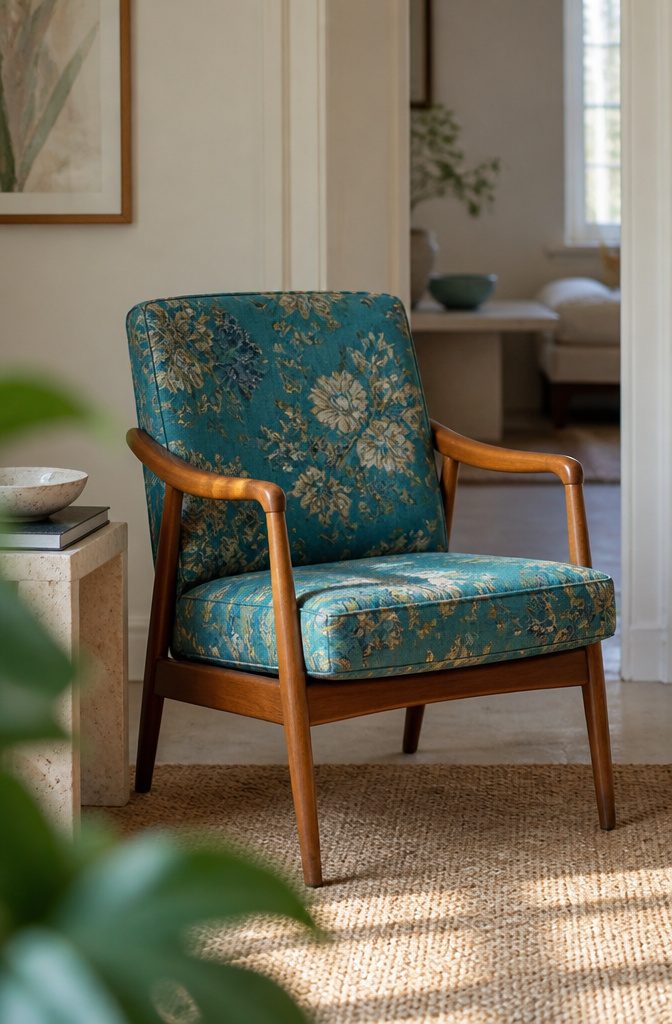
A vintage chair placed where it becomes the main thing you see works better than one competing for attention in a crowded arrangement.
The piece needs breathing room to register as the visual anchor it is, which usually means setting it against a simpler backdrop or in a spot where light hits it first.
The teal floral mid-century chairs with warm wood frames I looked at prove the point: saturated pattern that bold reads as playful rather than busy when the rest of the room stays neutral.
The color carries without the chair turning into clutter.
A French country settee in soft damask does the same thing by working with bleached beams and walls that recede rather than compete, letting the curved silhouette and fabric texture stand out as the room’s centerpiece.
Context decides whether the chair lands. A bold finish or saturated upholstery needs plain surroundings; an ornate frame benefits from clean lines elsewhere.
Light placement helps too. A chair near a window or under pendant lighting draws the eye before anything else does, which is the whole idea when the chair is the reason someone walks into the room.
2. Mix Vintage Chairs with Contemporary Furniture
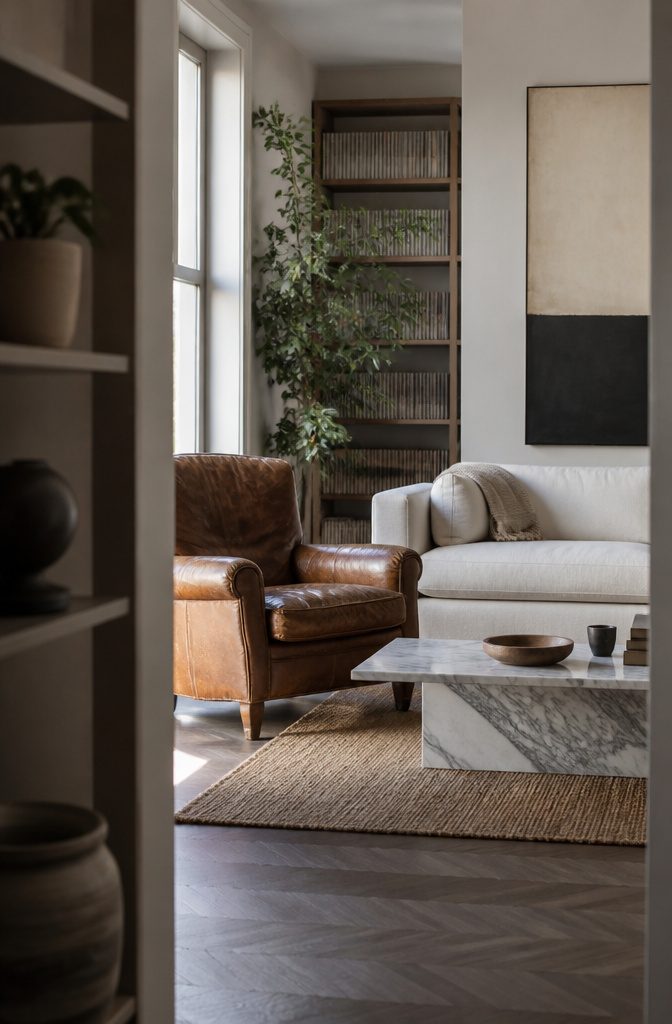
A sleek modern sofa paired with a vintage leather armchair adds contrast that catches the eye.
The mix works because the old piece brings texture and history without forcing the whole room into a period setting. That vintage chair becomes a focal point against clean contemporary lines rather than blending into a themed arrangement.
I prefer pairing pieces that differ in material rather than just style. A vintage marble-topped table next to contemporary upholstered seating creates a layer of visual interest that either piece alone would miss.
The marble carries weight and age, the upholstery stays soft and current, and neither has to match the other’s era to make the room feel intentional.
This approach works especially well in newer homes where architectural character is thin.
A reclaimed wood bench used as a kitchen island or an antique Venini chandelier in a modern dining room adds intrinsic detailing that drywall and builder-grade trim leave out.
3. Mix Chairs or Patterns for an Eclectic Look
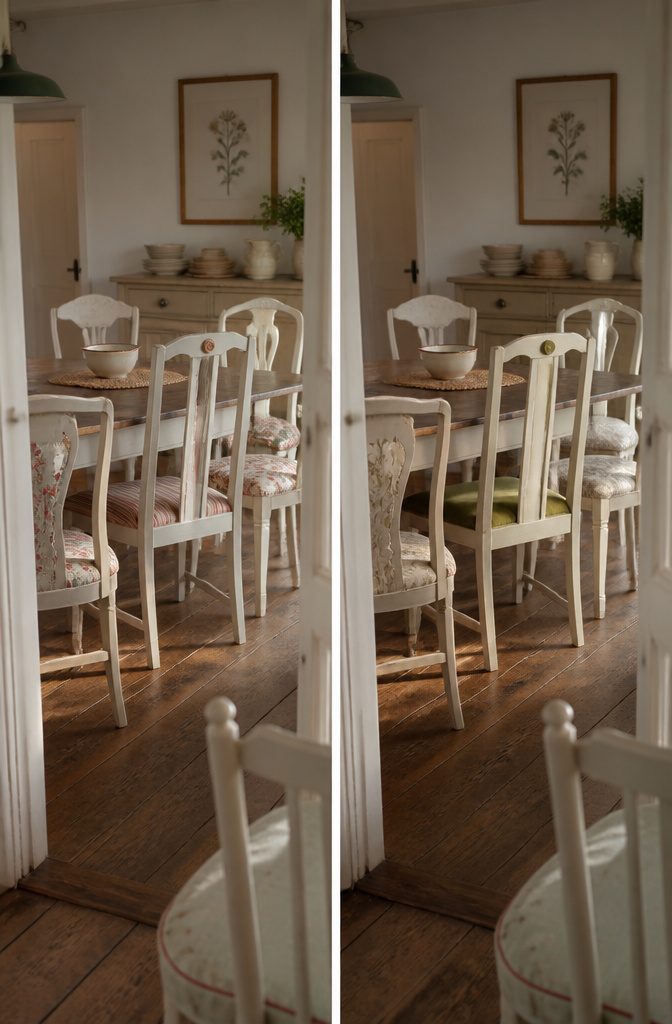
I ran five of those mismatched chairs through two coats of the same warm white before upholstering each seat in a different fabric — a stripe, two florals, a velvet, a printed linen — and the variation that looked chaotic before paint suddenly read as collected rather than random.
A shared finish or color holds the set together even when styles and fabrics differ.
Alice Marns points to a chair where multiple patterns worked because all the fabrics came from one supplier and sat in the same palette; she used matching piping and accent buttons in one repeating color to balance the mix across the piece.
The detail that makes or breaks it is that thread of similarity: Wendy Conklin mixed three chair styles in one dining room but painted every frame the same soft off-white so the upholstery could vary without the room falling apart.
For dining chairs, a theme as simple as distressed finishes or coordinating jewel tones is enough to turn thrifted finds into something that looks intentional.
4. Refresh the Chair’s Upholstery or Fabric
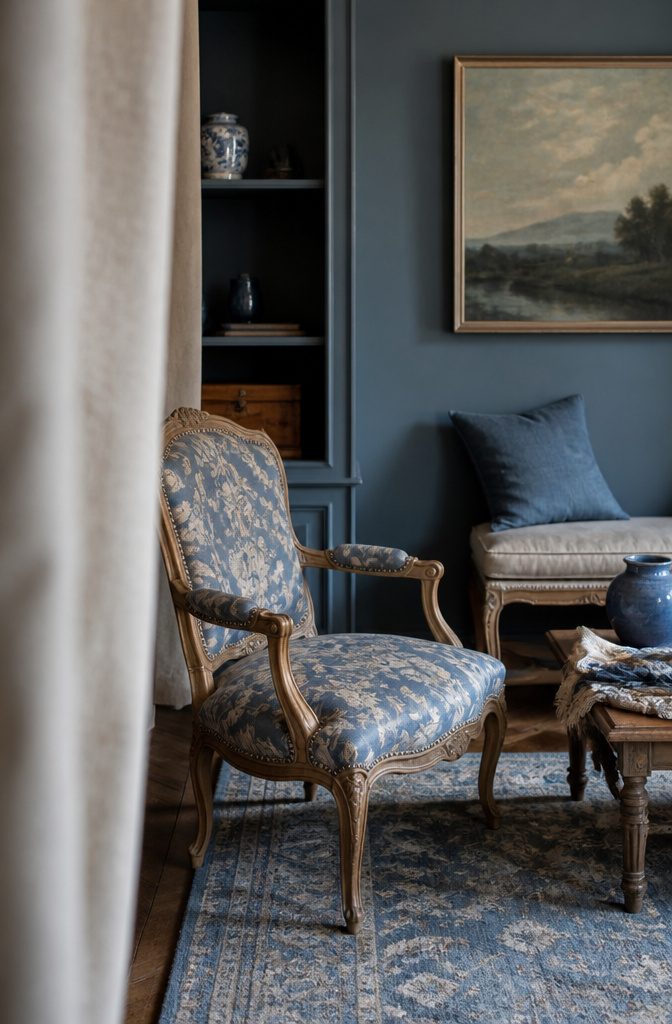
The fabric you choose matters more than the chair’s age. Match the fabric to the frame’s era and the result feels intentional rather than mismatched.
Mid-century chairs respond well to bold, tapestry-weight patterns like Pierre Frey fabric, which pairs modern lines with traditional detail. French-style frames with carved wood details look stronger in blue florals or gilded upholstery accented with gold wax on the carvings.
If the chair’s lines are simple and the room needs a statement, go for oversized florals or bright patterns.
Christopher Farr Cloth’s Dodoma fabric works for patchwork projects that combine remnants into a single seat, turning scraps into something usable. Mexican textiles, Moroccan prints, and Otomí animals add color and pattern without requiring perfect condition underneath.
For chairs that will stay in place, I favor fabrics with texture over flat weaves. The upholstery anchors the chair to the room’s palette, so pull a color from what is already there rather than introducing a new one.
5. Use Paint or Finish to Change the Chair’s Look
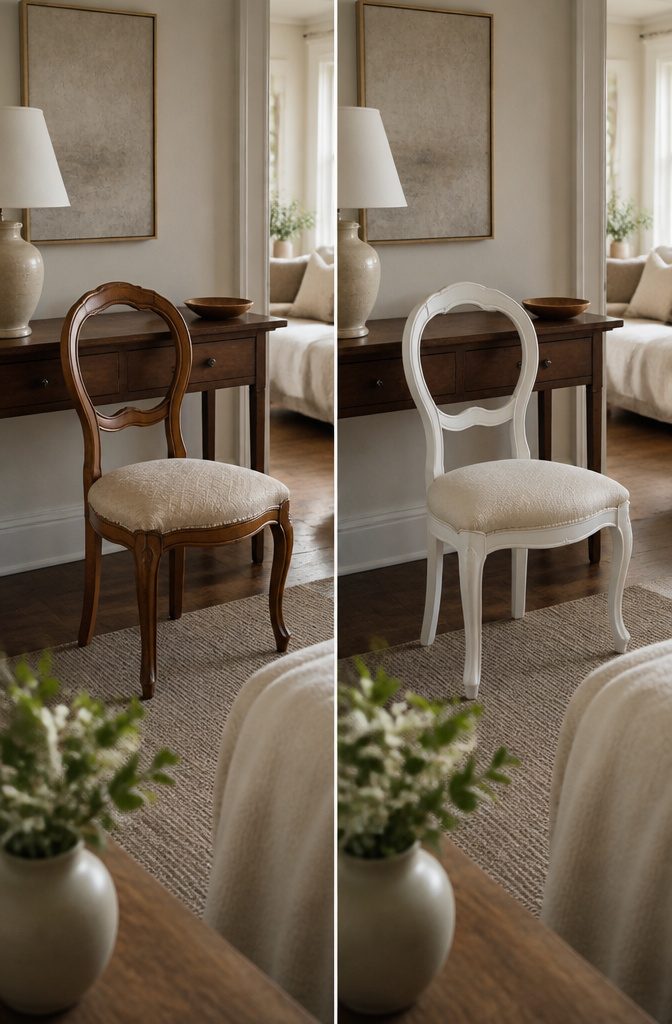
Paint lets you shift a vintage chair into a completely different mood without touching the upholstery.
A frame stripped down and given a clean white or black finish can look entirely new, which is the move if the chair’s lines are good but the era it signals is wrong for the room.
You can also go the opposite direction and highlight carved details with a metallic wax like Rub ‘n Buff in gold, which picks out the curves and flourishes on older French or Victorian pieces without making the whole thing shiny.
For something more unusual, a faux leather finish uses paint mixed with fabric softener over smooth fabric to mimic distressed leather.
Work in layers with different shades to get depth instead of a flat coat. It takes patience, but the result reads as reupholstery from across the room and costs a fraction of actual leather work.
6. Create a Nook or Reading Spot
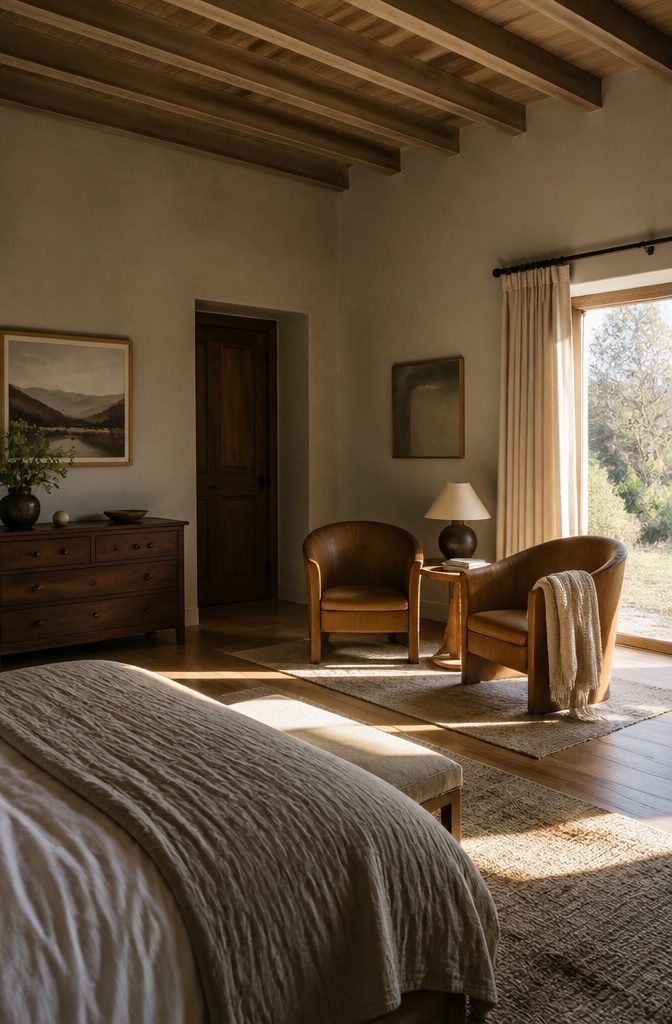
A pair of vintage chairs tucked into a corner with a small table between them makes a quiet retreat that doesn’t need much space.
I position them in a bedroom corner or an unused stretch of the living room, the kind of spot that feels separate without walls.
A two-door elm cabinet or a simple table holds books and a lamp, and that’s enough to mark the area as somewhere to sit for longer than a minute.
Barrel chairs work especially well here. The high, rounded back curves into the armrests and sits low to the ground, which makes the whole setup feel grounded rather than perched.
They gained traction in the early 19th century, had a second life in the ’30s during Frank Lloyd Wright’s time, and the proportions still read as deliberate now.
A single chair works too if the room won’t hold two.
I set it near a window where the light falls directly on the wood grain, pair it with a soft rug underneath, and the craftsmanship shows without staging the rest of the room around it.
The rug softens the floor and pulls the chair into the space rather than leaving it floating.
7. Place a Chair in a Dining Area
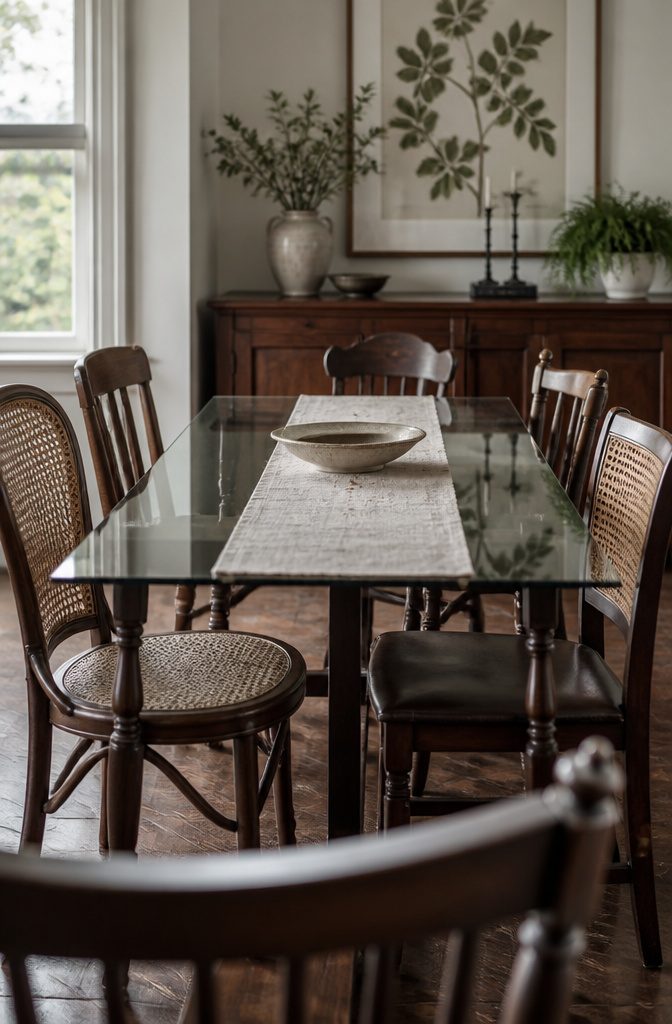
A vintage chair paired with a modern dining table creates contrast that feels intentional rather than accidental.
The simplicity works both ways: a glass or metal table lets carved or turned chair legs stand out, while a clean-lined chair keeps attention on an interesting table base.
I like chairs with caning or a mix of materials, such as the Zoey Caned Armless Dining Chair or the Dalton Leather and Cane Dining Chair, though leather and cane together can read as busy if the table already has detail.
Mismatched seating is where this idea gets interesting. A set of vintage chairs in coordinating finishes or a common color theme looks deliberate, not random.
You can mix wood tones, vary the back styles, or tie them together with matching paint or upholstery fabric. The result feels collected over time, which is what good eclectic design is supposed to look like anyway.
8. Repurpose a Chair or Stool as Another Useful Object
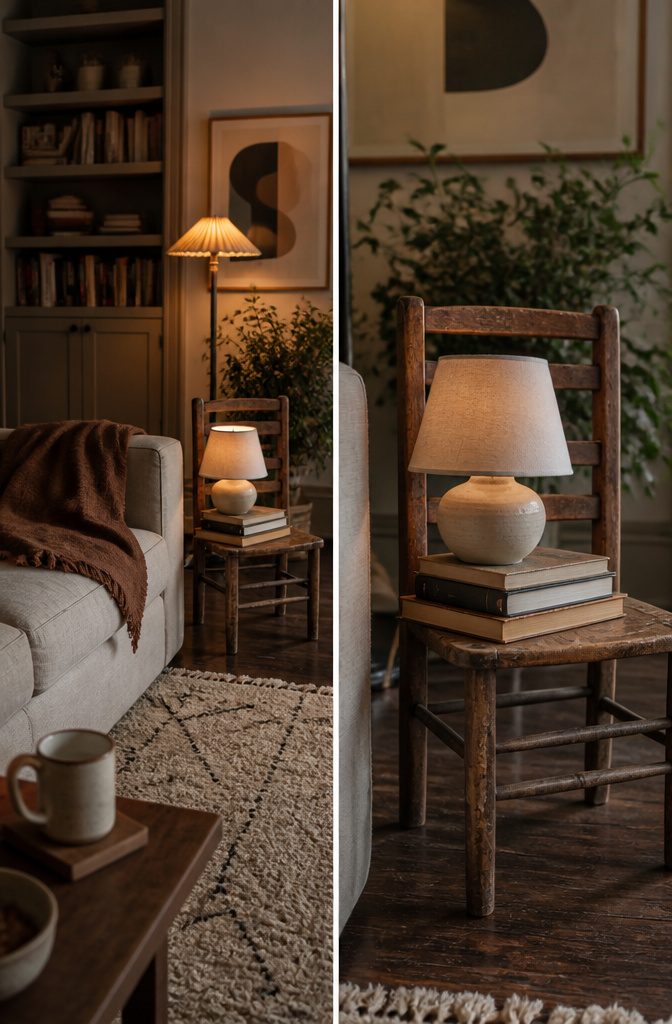
A rickety chair seat becomes a side table the moment you set a coffee, a remote, or a magazine on it.
The height works perfectly next to a sofa or bed, and a chair built to hold a person can easily support a lamp or a stack of books.
If the back is still intact but the seat is too far gone to repair, hang the back on the wall as decor and use the seat as a table in front of a window or beside an armchair.
Small vintage chairs work just as well outdoors. A child’s chair in its original paint makes a sturdy low table for drinks on a patio, and the weathered finish only adds character.
Old stools refresh easily with paint or new upholstery and can move between rooms as a vanity seat, a plant stand, or an accent table wherever you need one. The frame matters more than the original purpose.
9. Use Chairs as Wall Decor
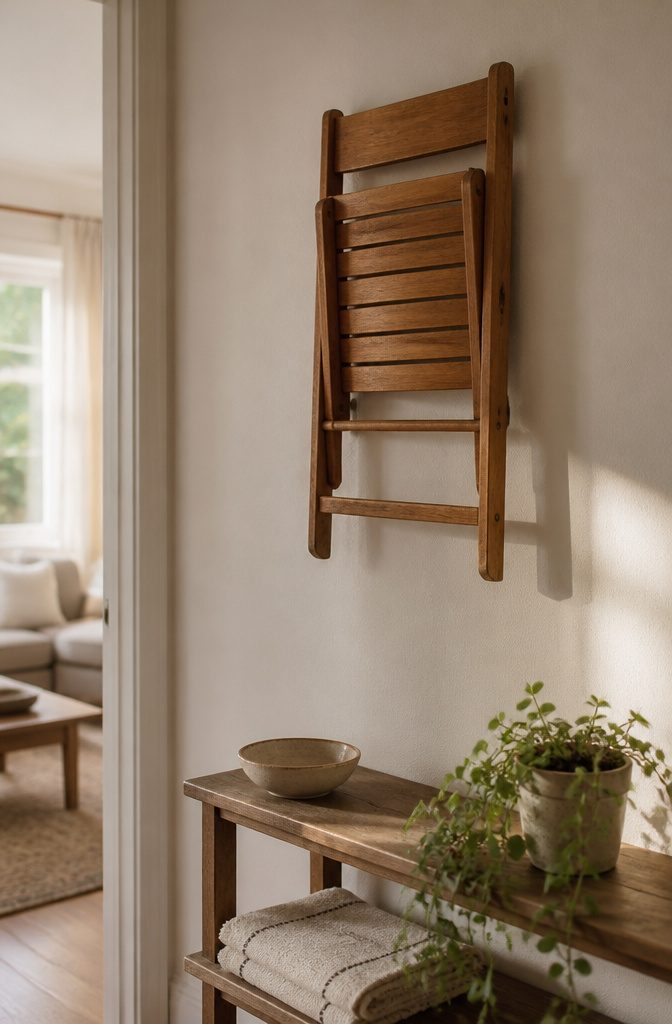
A folding chair hung on the wall reads as collected architecture rather than just decor. The lightweight oak frame means you can secure it with a sawtooth hanger and a sturdy picture hook or wall anchor, no special hardware required.
If you hit a stud, use it; if not, anchors rated for the chair’s weight do the job.
The display side matters. I hang mine with the back facing out so any lettering or maker’s mark stays visible—those small details are what separate a found piece from something that could have come from anywhere.
Attach the sawtooth hanger to the opposite side, measure your spacing before you mark the wall, and hang the chair carefully. The whole process takes less than an hour.
For a bolder approach, layer framed art onto the rungs of a folding chair. The vertical slats become a built-in grid, and the mix of frame shapes against wood adds depth without covering the chair completely.
10. Use a Chair in an Entryway or Hallway
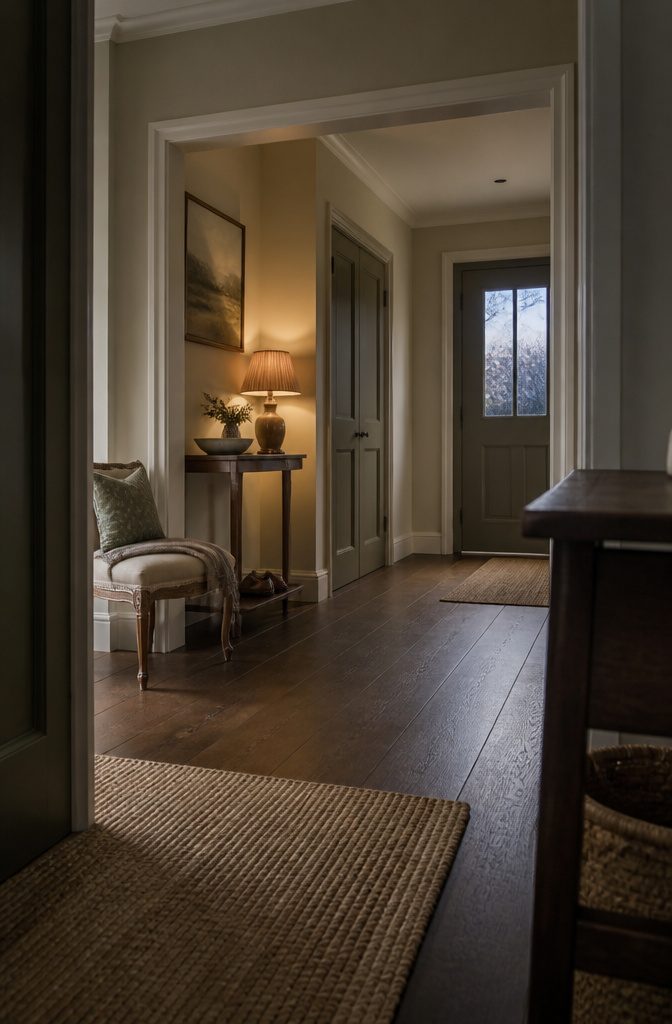
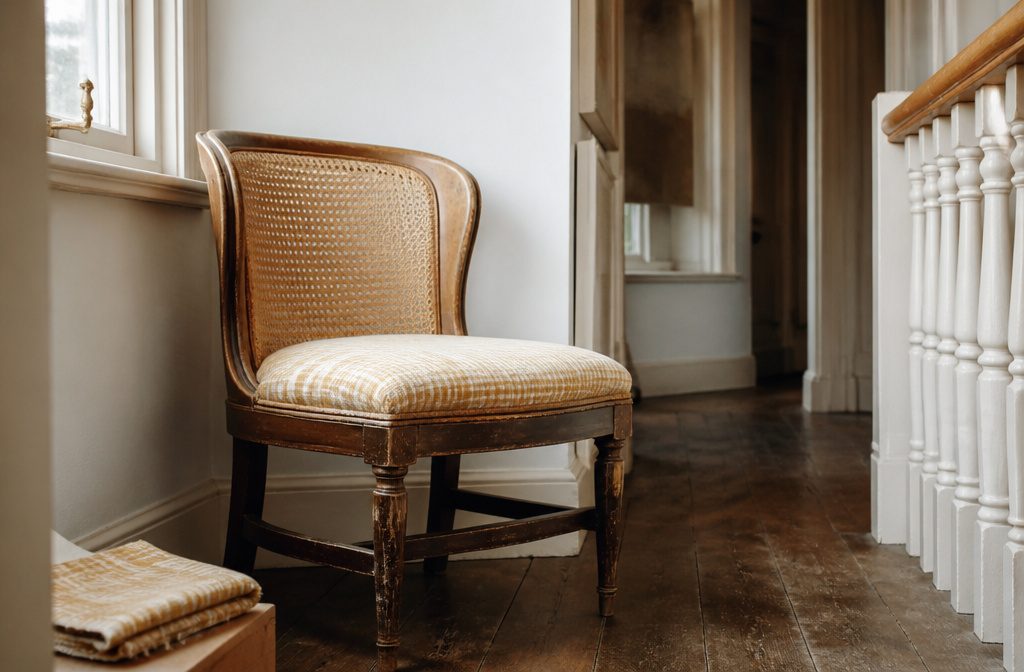
An antique chair tucked into a hallway or entryway works as accent seating that adds warmth without taking up much space.
I like pairing it with a decorative pillow or a soft throw blanket, both of which make the chair look intentional rather than like something waiting to be moved elsewhere.
The pillow gives you a chance to pull in a color from the room beyond, and the throw softens the wood or metal frame if the chair leans industrial or spare.
Hallways and entryways are transitional spaces, so the chair does not need to be a workhorse. It is there to look good and offer a spot to sit when someone needs to pull on shoes or set down a bag.
Keep the scale in proportion to the width of the hallway. A chair with arms can crowd a narrow passage, while an armless dining chair or a low slipper chair fits better.
Choose a Chair with Good Bones
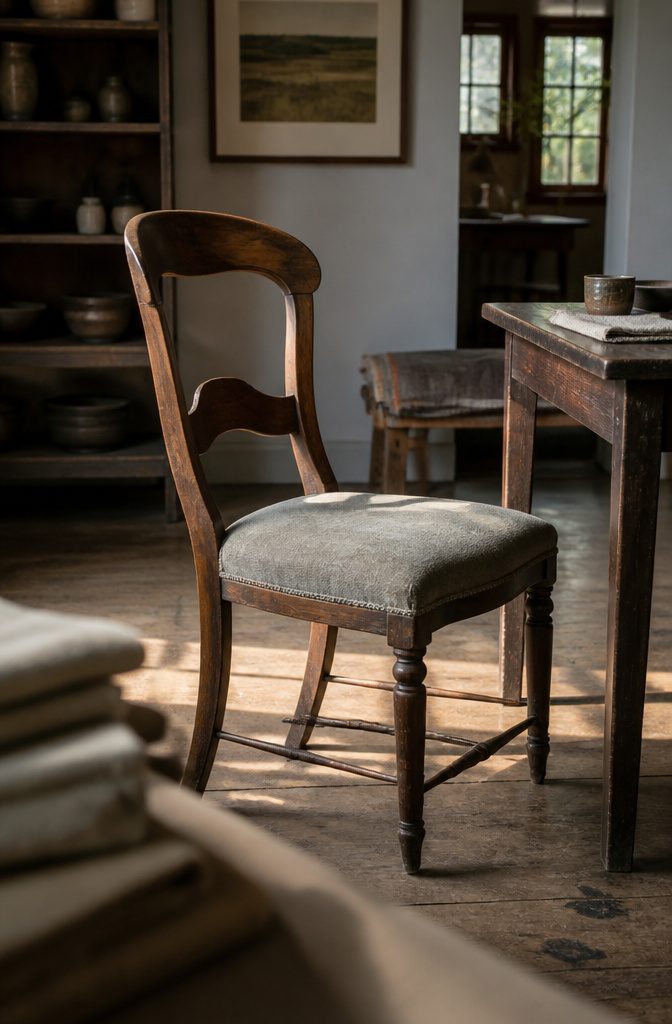
I always look at the frame first. A chair can have fabric that makes you wince, but if the wood is solid and the joints are tight, you can work with it.
Structural integrity decides whether a piece is worth bringing home — cracked wood and loose construction are harder to fix than any upholstery job, and sometimes they are not fixable at all.
The shape matters just as much. I look for a profile that reads clearly from across the room, something with a curve or angle that feels specific to its era.
A well-made piece from the 70s or 80s might be buried under tired fabric, but the bones underneath are what you are buying. If the silhouette is strong and the frame is sound, the rest is just surface work.
Before I think about styling or placement, I make sure the piece can actually hold up to use.
A chair with good bones gives you options. One with structural problems limits you from the start.
Keep Old and New Visually Balanced
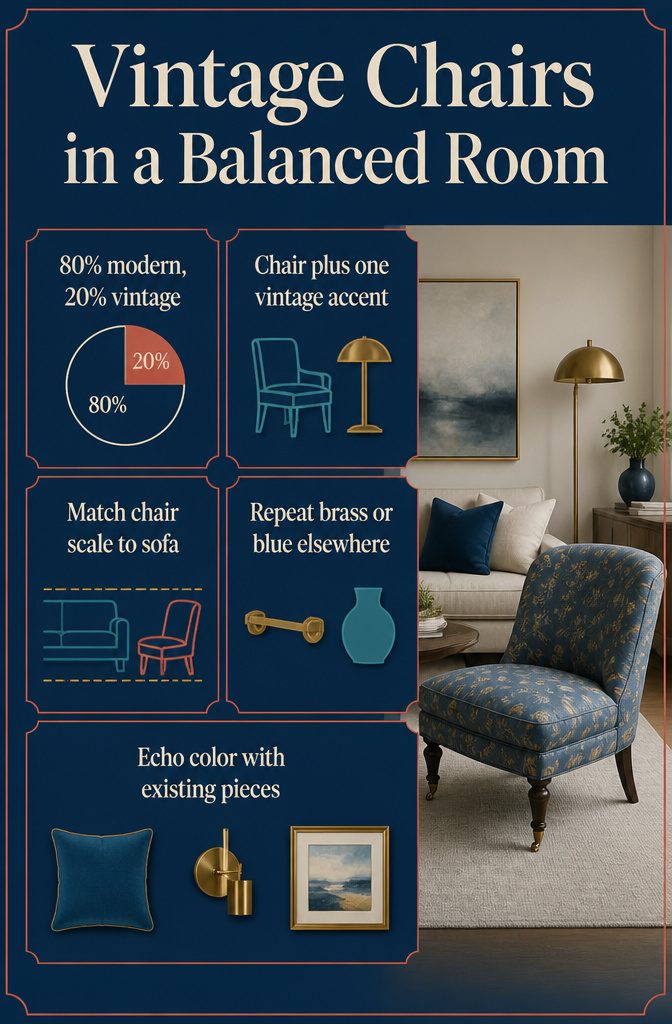
I start most rooms 80% in one direction, 20% vintage—it keeps a vintage chair from fighting every other piece for attention. A modern living room stays modern, with the vintage chair as the standout rather than one of five competing statements.
That 20% gives you room for the chair plus maybe a brass lamp or a weathered frame, but not much more before the room loses its anchor.
Scale decides whether the mix reads as intentional or accidental. A low-slung vintage slipper chair works next to a streamlined sofa because the proportions stay in conversation—neither dwarfs the other.
A tall wingback next to delicate mid-century legs looks like a mistake, even if both pieces are beautiful on their own.
Before you commit to a chair, picture it next to what it will live beside, not just against the wall where you found it.
Color is what makes an 80/20 split feel like one room instead of two ideas jammed together. If the vintage chair brings in warm brass tones, let those show up in your modern light fixtures or cabinet pulls.
A coastal blue chair gets echoed in throw pillows or a vase across the room, even if everything else skews contemporary.
It is those repeated notes that make a space look considered rather than accidental, and they cost nothing beyond noticing what is already there.
Frequently Asked Questions
What are vintage folding chairs?
Vintage folding chairs are lightweight wooden or metal chairs produced between the 1920s and 1970s, originally made for events, rentals, schools, or community gatherings.
Many feature slim oak frames, stamped maker markings, or rental company labels that add character when repurposed as decor. They work well as wall art because of their slim profile and architectural detail.
Can vintage folding chairs be used as wall decor?
Yes. A folding chair hung on the wall reads as collected architecture rather than just decor, and the lightweight oak frame means you can secure it with a sawtooth hanger and a sturdy picture hook or wall anchor.
Hang it with the back facing out so any lettering or maker’s mark stays visible, or layer framed art onto the rungs for added depth.
Where can I find vintage folding chairs?
Try thrift stores, antique shops, estate sales, flea markets, consignment shops, yard sales, garage sales, Etsy, or eBay. Look for slim wooden designs with original patina, maker stamps, or rental markings, which add authenticity and styling interest.
How much do vintage folding chairs cost?
You can expect to pay $25 to $100 per chair at thrift or consignment shops, depending on condition, age, and maker. Rare or branded examples may cost more at antique markets.
Are vintage folding chairs considered antique?
Not necessarily.
Vintage folding chairs are generally less than 100 years old, while antiques are typically 100 years or older. However, older folding chairs with historical provenance may fall into antique categories depending on age and documentation.
Why are vintage chairs better than modern ones?
Vintage chairs often feature superior craftsmanship, durable materials, and personal style that sets them apart from mass-produced modern options. Choosing vintage also means reusing rather than buying new, which adds both character and sustainability to a space.
What is the difference between vintage and antique chairs?
Vintage chairs are 20 to 99 years old, while antique chairs are at least 100 years old. The distinction matters for collectors and pricing, though both terms describe older furniture with historical interest.
How do you identify vintage chairs?
Check for era clues, maker’s marks, construction quality, joinery, and hardware. A chair with good bones shows solid wood, tight joints, and a silhouette that feels specific to its era, even if the upholstery has seen better days.
How to make vintage furniture look modern?
Pair a vintage chair with contemporary furniture so the old piece brings texture and history without forcing the whole room into a period setting.
A sleek modern sofa next to a vintage leather armchair adds contrast that catches the eye, and paint can shift a frame into a completely different mood without touching the upholstery.
What are some creative ways to repurpose an old chair?
A rickety chair seat becomes a side table the moment you set a coffee, a remote, or a magazine on it.
If the back is intact but the seat is too far gone, hang the back on the wall as decor and use the seat as a table beside a window or armchair.
Old stools refresh easily with paint or new upholstery and can move between rooms as a vanity seat, a plant stand, or an accent table.